Leslyn Lewis urges Canadians to fight WHO pandemic treaty before it’s legally binding
Conservative MP Leslyn Lewis is urging Canadians to demand a parliamentary debate on the WHO Pandemic Agreement, highlighting risks to national sovereignty.
Wed Oct 29, 2025 - 4:03 pm EDT
OTTAWA (LifeSiteNews) – Conservative Member of Parliament (MP) Leslyn Lewis called on Canadians to petition against the World Health Organization’s (WHO) pandemic treaty before it becomes legally binding.
In an October 23 post on X, Lewis encouraged Canadians to demand that politicians debate the WHO Pandemic Agreement before it becomes law after warnings that the treaty could undermine national freedom and lead to global surveillance.
“I have raised red flags about its implications on Canada’s health sovereignty and the federal government’s willingness to enter a legally binding treaty of this weight without any input from Parliament,” she declared.
In May, Canada, under Liberal Prime Minister Mark Carney, adopted the treaty despite warnings that the agreement gives the globalist entity increased power in the event of another “pandemic.”
However, Lewis revealed that since the agreement has yet to be officially signed, Canada is not bound to it and can still make amendments.
“We are now in a critical window of opportunity to ask tough questions and debate the treaty before it is signed by the Minister of Foreign Affairs and binds our nation,” she explained.
Lewis encouraged Canadians to sign a petition calling for a debate of the agreement as well as contacting their local MPs to request a parliamentary review of the treaty.
Lewis revealed that Canadians’ persistent opposition to the treaty has already resulted in some of the more dangerous clauses, including restricting free speech, freedom of movement, and government surveillance, being removed from the final agreement.
“Thanks to the engagement of countless Canadians and concerned citizens around the world, the most extreme provisions in the WHO Pandemic Treaty were removed — these measures would have undermined national healthcare sovereignty and given international bureaucrats sweeping powers,” Lewis declared.
“The removal of provisions on vaccine mandates, misinformation and disinformation, censorship requirements, travel restrictions, global surveillance, and mandatory health measures happened because people paid attention and spoke up,” she continued.
Among the most criticized parts of the agreement is the affirmation that “the World Health Organization is the directing and coordinating authority on international health work, including on pandemic prevention, preparedness and response.”
MRSA stands for Methicillin-resistant Staphylococcus aureus.
It is a type of staph bacteria that has developed resistance to many common antibiotics, including methicillin, amoxicillin, and penicillin.2 This makes MRSA infections more difficult to treat than ordinary staph infections.
-----------------------------
Key Facts About MRSA
Staphylococcus aureus (or "staph") is a common type of bacteria that usually lives harmlessly on the skin or in the nose of about one-third of people.
MRSA is a specific strain of staph that has become resistant to a broad group of antibiotics.
It most often causes skin infections, but it can also lead to more serious, potentially life-threatening infections in the bloodstream, lungs, bones, joints, and other parts of the body.
------------------------------
Types and Symptoms
MRSA infections are generally categorized by where they are acquired:
Type of MRSA / Where it's acquired / At Risk Populations
HA-MRSA
(Healthcare-Associated)Hospitals, nursing homes, dialysis centers, and other healthcare settings.People with weakened immune systems, those who have had recent surgery, or those with medical devices (IVs, catheters).
CA-MRSA
(Community-Associated)Among otherwise healthy people in the wider community.People involved in contact sports, those in crowded or unsanitary living conditions, and children in daycare.
Common Symptoms (often starting as skin infections):
A swollen, painful red bump that might look like a pimple, boil, or spider bite.
The area may be warm to the touch and filled with pus or other drainage.
In more serious cases, the infection may be accompanied by a fever.
If you suspect you have an infected wound that is getting worse or is accompanied by a fever, it's important to see a doctor right away for diagnosis and treatment.
-----------------------------
Dealing with MRSA involves specific treatment strategies and diligent prevention measures to limit its spread, especially since it is resistant to many common drugs.
Treatment for MRSA Infections
Treatment for Mild Skin Infections
Drainage: For many common skin MRSA infections (like boils or abscesses), the primary treatment is often simply having a healthcare professional surgically drain the pus from the sore.
Oral Antibiotics: The doctor may prescribe oral antibiotics that are still effective against MRSA. Examples include drugs like trimethoprim-sulfamethoxazole (TMP-SMX), clindamycin, or doxycycline/minocycline. It is crucial to finish the entire prescription, even if you feel better.
----------------------------
Treatment for Severe or Invasive Infections
Intravenous (IV) Antibiotics: Serious infections affecting the bloodstream, lungs (pneumonia), or other organs usually require treatment with stronger antibiotics administered intravenously in a hospital setting.
Key IV Antibiotics: The cornerstone of treatment for severe MRSA is often Vancomycin. Other IV options that may be used include Linezolid, Daptomycin, and Ceftaroline.
Additional Procedures: If the infection is near a medical device (like a catheter or artificial joint), surgery may be necessary to remove the device along with antibiotic therapy.
-------------------------------
Prevention of MRSA Spread
Prevention is a critical step, especially in healthcare settings and community environments with close contact.
For Everyone (General Prevention)
Wash Your Hands
This is the single most effective defense. Wash often and thoroughly with soap and water for at least 20 seconds. Use an alcohol-based hand sanitizer (at least 60% alcohol) when soap and water are not available.
Keep Wounds Covered
Keep cuts, scrapes, and sores clean and covered with clean, dry bandages until they heal. Pus or drainage from a sore can contain MRSA.
Don't Share Personal Items
Avoid sharing towels, razors, washcloths, clothing, uniforms, or athletic equipment. MRSA can spread on contaminated objects.
Sanitize Linens
Wash towels and bed linens in hot water (with bleach, if possible) and dry them completely in a hot dryer if you have a sore or cut.
--------------------------------------
As the difference between being colonized and infected is fundamental to understanding MRSA.
The bacteria are living on or in the body without causing harm.
The bacteria have entered a part of the body (like a cut, wound, or internal organ) and are actively multiplying and causing damage.
Symptoms
None. The person is completely healthy and unaware they are carrying the bacteria. The bacteria are simply part of their normal skin/mucosal flora.
Clear signs of illness. Symptoms depend on the location, but commonly include:<ul><li>Skin: Red, swollen, painful bump/boil that may look like a spider bite. It is often warm to the touch and may leak pus/drainage.</li><li>Systemic (e.g., in the blood/lungs): Fever, chills, fatigue, difficulty breathing, confusion, or severe pain.</li></ul>
Contagiousness
A colonized person can still spread MRSA to others through direct contact or contaminated objects. This is why screening and precautions in hospitals are important.
An infected person can also spread MRSA, especially through pus/drainage from a wound.
Treatment
Usually not treated unless the person is about to undergo a high-risk surgery or if there's an outbreak in a healthcare setting. Treatment, when given, is often a topical cream (like Mupirocin in the nose) and a special body wash.
Requires treatment with antibiotics that are effective against MRSA (as discussed previously), and often drainage of an abscess.
Prevalence
Very common. Approximately 1/3 of the general population carries regular Staphylococcus aureus (staph), and a smaller percentage (around 2% in the community) carries MRSA without symptoms.
Less common than colonization, but is a serious public health concern.
----------------------------
In short:
Colonization is having the germ on you, but you are not sick.
Infection is having the germ in you, and it is making you sick.
Would you like to know more about the different types of MRSA (like HA-MRSA vs. CA-MRSA) and where they are typically found?
The closest and most likely heart affliction you are referring to is Paroxysmal Supraventricular Tachycardia (PSVT), which can also be referred to as Paroxysmal Atrial Tachycardia (PAT). This is a type of arrhythmia (irregular heartbeat) that causes episodes of an abnormally rapid, but regular, heart rate.
⚠️ Critical Medical Alert
PSVT and other arrhythmias are serious medical conditions that must be managed by a qualified cardiologist.
---------------------------------------
Recommended Steps
Confirm the Diagnosis: Speak with your cardiologist to confirm that the affliction is indeed PSVT or another type of tachycardia and to establish a conventional treatment plan.
Professional Consultation: If you wish to use homeopathy as a complementary approach, consult a registered, qualified homeopath who can tailor a remedy to your complete picture.
Monitor and Communicate: Always inform your cardiologist about any homeopathic or herbal supplements you are using to ensure they do not interact with your prescribed heart medications.
---------------------------------------
For a condition like Supraventricular Tachycardia (SVT)—which includes PSVT—lifestyle changes are a crucial part of management, often recommended alongside any necessary medical treatment.
Here are the key lifestyle and at-home strategies recommended by cardiologists and health professionals for managing SVT symptoms and reducing the frequency of episodes:
1. Identify and Avoid Triggers
The most important step is often tracking down and eliminating what causes your episodes. Common triggers include:
Caffeine: Coffee, tea, sodas, and energy drinks can speed up the heart and are a very common trigger.
Alcohol: Excessive (and sometimes even moderate) alcohol intake can trigger episodes.
Nicotine: Smoking and all tobacco products contain nicotine, a stimulant that stresses the cardiovascular system.
Stimulant Medications: Certain over-the-counter medications for cold, flu, and cough often contain stimulants like pseudoephedrine that can trigger a fast heart rate. Always check labels and consult your doctor.
Dehydration: Being dehydrated can affect your electrolyte balance, which is crucial for a stable heart rhythm.
2. Dietary and Nutritional Focus
Adopting a heart-healthy diet supports overall cardiovascular stability.
Focus Area / Action / Why it Helps
Hydration : Drink plenty of water throughout the day.Supports healthy blood volume and maintains proper electrolyte balance (sodium, potassium, magnesium).
Electrolytes : Eat foods rich in Potassium and Magnesium (e.g., bananas, leafy greens, nuts, seeds, sweet potatoes).These minerals are essential for the electrical function and stability of the heart cells.
Heart-Healthy Diet : Follow a diet rich in fruits, vegetables, whole grains, and lean proteins (like the DASH or Mediterranean diet).Helps manage blood pressure, weight, and cholesterol, all of which support heart health.
Avoid Heavy Meals : Avoid very large meals, especially right before bedtime.A full stomach can sometimes press on the vagus nerve (which controls heart rate) and trigger an episode.
3. Stress and Sleep Management
Emotional stress, anxiety, and lack of sleep are well-known triggers for SVT.
Stress Reduction: Incorporate daily practices like meditation, yoga, or deep breathing exercises to lower your baseline stress level. Managing anxiety is key, as the fight-or-flight response can directly trigger a fast heartbeat.
Quality Sleep: Aim for 7 to 9 hours of quality sleep each night. Poor sleep can be a major stressor on the body and the heart.
Manage Other Conditions: Treat conditions like sleep apnea, which is strongly linked to various arrhythmias.
4. At-Home Techniques (Vagal Maneuvers)
During a mild SVT episode, your doctor may teach you techniques to stimulate the vagus nerve, which helps control the heart rate and can sometimes abruptly stop an episode. Always get instruction from your doctor before attempting these:
Valsalva Maneuver: Close your mouth, pinch your nose, and bear down as if you are trying to have a bowel movement for about 10-15 seconds.
Coughing: A strong, vigorous cough.
Diving Reflex: Splashing ice-cold water on your face.
5. Physical Activity and Weight
Regular, Moderate Exercise: Regular physical activity (like walking, swimming, or cycling) strengthens the heart. Consult your cardiologist to determine a safe and appropriate exercise level for your condition.
Maintain a Healthy Weight: Losing excess weight reduces the strain on your heart and lowers the risk of developing or worsening other risk factors like high blood pressure.
--------------------------------
Do not attempt to replace conventional medical treatment with homeopathic remedies. Delaying or forgoing prescribed conventional treatment (such as medications, vagal maneuvers, or ablation) can lead to serious complications, including fainting, stroke, or heart failure.
Homeopathic and Natural Remedies Cited for Tachycardia/Arrhythmia Symptoms
In homeopathic and natural practice, remedies are selected based on the specific symptoms, triggers, and emotional state of the individual, not just the diagnosis of the fast heart rate.
A consultation with a certified homeopath would be necessary for an individualized prescription. However, some commonly mentioned remedies in homeopathic literature for palpitations and irregular heart rhythms include:
Spigelia AnthelmiaSharp, stitching, or violent pain in the chest; severe palpitations that are worse when bending forward or lying on the left side. Often cited for nervous heart symptoms.
Cactus GrandiflorusA sensation as if the heart is gripped, constricted, or caged with an iron band; feeling of a full, throbbing heart; often used for general cardiac ailments and some arrhythmias.
Aconitum NapellusUsed for sudden onset of intense, violent palpitations, often following a shock, fright, or great anxiety. Accompanied by fear of death and great restlessness.
GelsemiumHeart symptoms accompanied by great weakness, trembling, and a heavy, droopy feeling. Often used for performance anxiety or anticipation that can trigger palpitations.
Nux VomicaPalpitations or irregular rhythm from overindulgence (coffee, alcohol, rich food), stress, or anger. Symptoms often start in the morning.
Crataegus (Hawthorn)Often used as an herbal support (tincture) or a low-potency homeopathic remedy to help tone and strengthen the heart muscle.
Francis Collins Accidentally Reveals His Own Incompetence
[This article was originally published in December 2023.]
There’s long been a debate among pandemic realists as to what levels incompetence, malice, and power-seeking played in our Covid response.
We’ll never know for certain, though there are certainly strong arguments on both sides, particularly with politicians who seized their opportunity to enforce pointless, authoritarian mandates. And this included “experts” who after years of toiling in obscurity decided to impose their values and views on others.
Most famously this would prominently feature Dr. Anthony Fauci, who went from quickly dismissing masks to becoming tyrannically obsessed with demonizing anyone who criticized him or questioned his status as The One True Representative of The Science™.
Ironically, in 2023 we’ve now seen more research on the possibility that masks actually made Covid transmission and infection worse.
But now another important, influential “expert” has just spoken on a panel sharing what thoughts were going through the esteemed minds of some of our government officials and advisors during the early days of the Covid response. And in doing so, he unwittingly made a major admission illustrating, at the very least, his own incompetence.
Francis Collins Shows How Little Thought ‘Experts’ Gave To Covid Restrictions
Francis Collins was for most of the Covid pandemic one of the most influential and powerful health “experts” in the US government. Collins, as head of the National Institutes of Health, wielded enormous amounts of control over both the political actions, restrictions, mandates, and recommendations issued by the government, as well as the public communications made during the early parts of the pandemic.
And it’s clear that did not do a good job. When listening to his own words, it’s certainly evident why his time in the limelight was so disastrously harmful.
The Wall Street Journal covered the panel and a portion of what Collins said.
Collins told the audience that public-health officials had placed “infinite value” on policies they thought would save lives and “zero value to whether this actually totally disrupts people’s lives.” The Covid vaccine wasn’t yet available, and officials felt a moral imperative to slow the alarming number of deaths.
“We weren’t really thinking about what that would mean to Wilk (another panelist from the Midwest) and his family in Minnesota, 1,000 miles away from where the virus was hitting so hard,” Collins said.
There’s a lot to unpack in just these few sentences. Collins clearly admitted that a sense of self importance, hubris, personal fear, and an obsessive focus on a few specific locations obscured how vastly different the situation and their responses would play across a massive, continent-sized country. That’s bad enough. But the first quote is much, much worse.
Collins also acknowledged that the public health profession, the profession he was effectively leading during the most important crisis of its modern existence, paid quite literally “zero” attention to what the ensuing trade-offs would be from the immense and unconstitutional restrictions imposed on the public.
That’s correct, unprecedented, awe-inspiring restrictions on the freedom of movement, on the freedom of business owners to operate, the freedoms of children to attend school, of people to go about their days without the farcical theater of masking, attend events at full capacity — the freedoms we all take for granted that were removed for months, if not years on end, were enacted with “zero” consideration for the ancillary consequences and harms.
It’d be unbelievable, if it wasn’t such a perfect example of the ineptitude, incompetence, stupidity, and desire for control at the core of “public” health.
Those in charge apparently could not have cared less about the impact their mandates would have on the public. Their prime concern was implementing what they believed would be effective, despite a clear lack of supporting evidence in favor of their policies, which has unfortunately been reinforced over and over again in the post-pandemic era.
He wasn’t finished there.
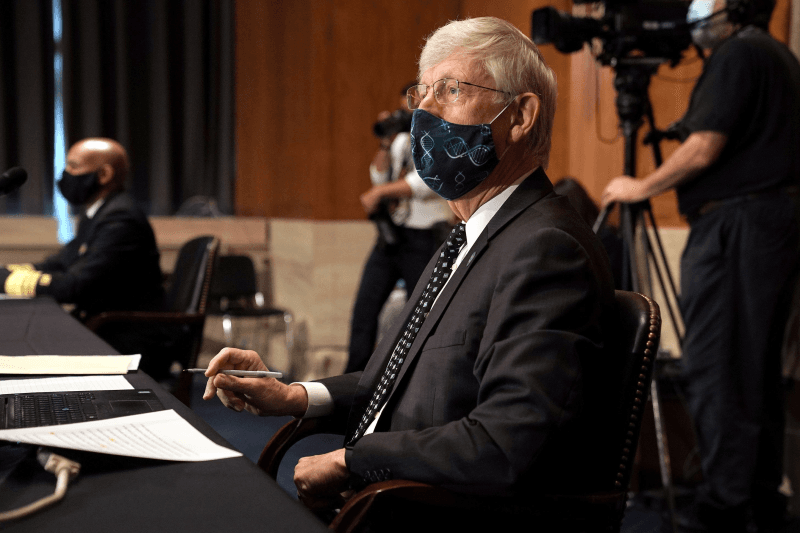
WASHINGTON, Sept. 9, 2020 (Xinhua) — U.S. National Institutes of Health (NIH) Director Francis Collins (front) attends the U.S. Senate Health, Education, Labor and Pensions Committee hearing titled “Vaccines: Saving Lives, Ensuring Confidence, and Protecting Public Health” on Capitol Hill in Washington, D.C., the United States, on Sept. 9, 2020. (Greg Nash/Pool via Xinhua) (Photo by Xinhua/Sipa USA)
Collins Lies About Sweden While Ignoring Their Example
Collins also unwittingly admitted how little attention he paid to his literal one job when it came to pre-pandemic planning.
According to his analysis, “public health people” were narrowly focused on any decision that “will save a life.”
“The public health people, we talked about this earlier, if you’re a public health person and you’re trying to make a decision, you have this very narrow view of what the right decision is, and that is something that will save a life.
This, of course, ignores that a decision that may save a life due to a reduced spread of disease, may cost another person their life due to increased rates of abuse, obesity, loneliness, or loss of income or employment.
Pre-Covid planning documents on how to handle pandemics often specifically mention trade-offs. For example, the World Health Organization warns that school closures and border closures could cause severe harm, with little in the way of proven benefits. Had Collins, you know, done his job, he’d have evaluated risks and harms, as that is exactly what public health is supposed to do. But according to him, they ignored any trade-offs in favor of unproven policies that may save lives.
Though very often they didn’t.
Similarly, he admitted that their advocacy for school closures and partnership with teachers unions on extending them, ensured that kids “never quite recovered.”
We’re all looking for the guy who did this, aren’t we?
And in perhaps an even more remarkably revealing example of disastrous incompetence, Collins openly lied (see Twitter link for video) about Sweden’s early Covid response.
Sweden, as a reminder, was one of the few countries to follow the pre-pandemic planning documents and consider the ancillary consequences of completely shutting down normal life, keeping kids out of school, recommending universal masking and imposing vaccine passports.
Collins though, desperate to avoid dealing with the ramifications of his own idiocy, claimed Sweden, due to a high rate of Covid mortality in the early days of the pandemic, was a failure. He, in fact, inaccurately said that Sweden, in the first few months of 2020, had a “higher death rate than anywhere else in Europe.”
This is demonstrably, horrifically false.
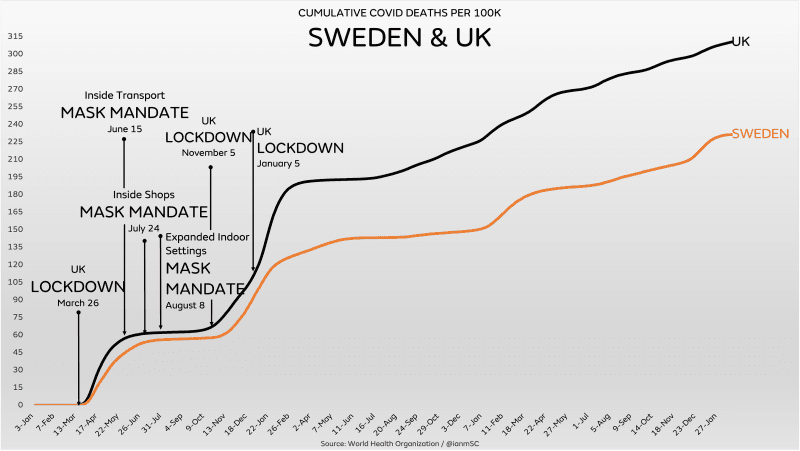
Here’s just one example; the UK had higher Covid mortality per 100,000 than Sweden for the entire pandemic.
That gap started in 2020 and only increased over time despite the UK’s masks and lockdowns and eventual vaccine passports.
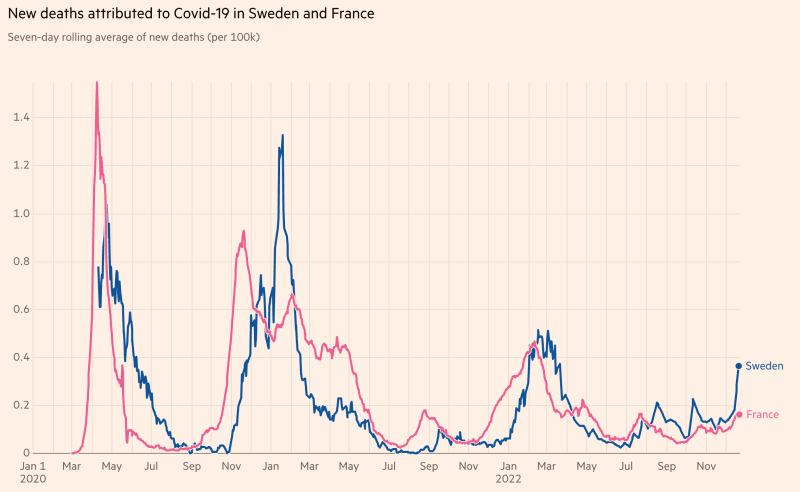
France had a higher Covid mortality rate for much of 2020 and 2021 too.
So did Italy. And Spain. And Belgium. The Netherlands 2020 peak was nearly identical. Portugal’s peak of Covid deaths, albeit a bit later, was double that of Sweden’s.
You quite literally cannot be more wrong than Francis Colins has been when trying to defend his mistakes compared to Sweden’s more successful hands-off approach. And with his inaccuracy, he involuntarily proved just how incompetent he and his professional cronies were during the early days of Covid, which unfortunately continues to this day.
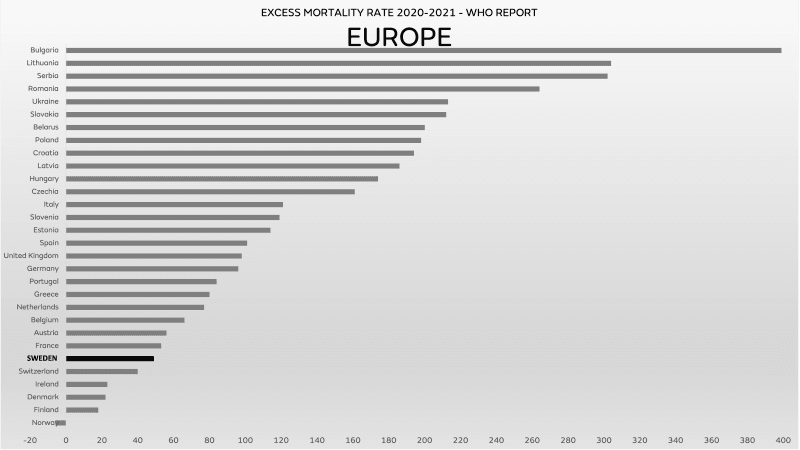
It’s important to remind everyone that Sweden had among the lowest rates of excess mortality in Europe from 2020 to 2021.
And those numbers even improved among European countries throughout 2022.
Francis Collins isn’t someone to be taken seriously. Quite clearly, he advanced into his position through ambition, political skill, and networking. Because if he had any relevant qualifications, expertise, or awareness that would have served the American people during the biggest pandemic in a hundred years, we would have seen those capabilities in some action or statement during Covid.
Instead, he conspired with Fauci to inaccurately downplay the lab leak and insult anyone who disagreed with him. He helped spur on the disastrous series of mistakes that would cost the country incalculable amounts of money, mental health, and educational progression and opportunity.
And even in the post-pandemic period, he acknowledges how little he worried about all those lives he was upending, the children he hurt, the vast disparities in lifestyles between his small, insular world of Washington elites and those in the rest of the country, or the fact that his preferred mandates would have ancillary consequences, with literally nothing in the way of proven, evidence-based benefits.
His ignorance of Sweden’s overwhelming success is just one of the many disqualifying, offensive statements made during this panel discussion.
No matter how low our opinion is of the “expert” class, it’s clearly not low enough.
For reprints, please set the canonical link back to the original Brownstone Institute Article and Author.
Author
Ian Miller is the author of “Unmasked: The Global Failure of COVID Mask Mandates.” His work has been featured on national television broadcasts, national and international news publications and referenced in multiple best selling books covering the pandemic. He writes a Substack newsletter, also titled “Unmasked.”
The BLS has come out with another huge rug-pull on its nonfarm payroll count. And also, predictably, this has triggered loud blathering from both Wall Street and the White House on behalf of exactly the wrong conclusion.
To wit, we don’t need any more Fed rate cuts! And we don’t need a new eruption of money-printing, either, because the real cost of debt is already dirt cheap.
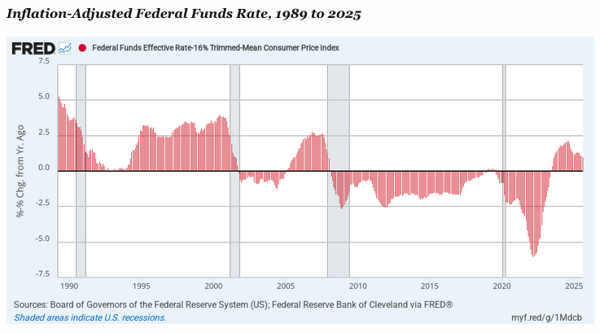
For instance, here is the inflation-adjusted Fed funds rate over the last four decades:
Since the turn of the century, the geniuses on the FOMC have pegged the real Fed Funds Rate at negative levels nearly 80% of the time. And even as of July 2025—three years after allegedly pivoting to inflation-fighting—the real Fed funds rate is only positive by 110 basis points. That’s far below real rates of 250 to 500 basis points, which prevailed before Greenspan went all in on money-printing in response to the dot-com bust.
Still, based on the blatant noise in the BLS’s “useless” jobs numbers, as they were described by even JD Vance, the rate cut chorus implies that the current skinny 110 basis points of positive return to savers and depositors is way too much.
Supposedly, the dire economic weakness implied by the BLS error confession means that the real cost of overnight money for gambling and other short-term purposes should be shoved back below the zero bound yet again in order to keep the economy from tumbling into the recessionary drink.
To be sure, another recessionary spell may well be underway. But for crying out loud—it’s not due to high interest rates. To the contrary, it is the easy-money fostered mountain of public and private debt—now totaling $103 trillion—that has ground economic expansion to a halt.
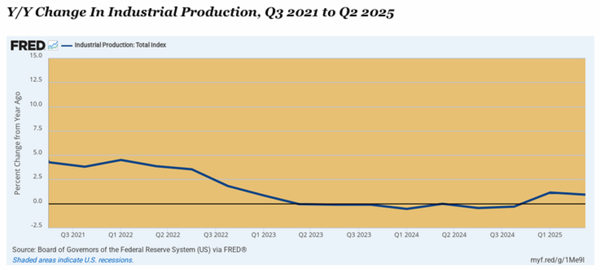
And we do mean a near halt. Industrial production, for instance, has been essentially flatlining since Q2 2023.
The truth is, the Fed’s elephantine balance sheet and interest rate-pegging regime are also still fueling dangerous financial bubbles and rampant speculation.
The Fed’s interest rate repression has so distorted the debt markets, in fact, that it has enabled the Wall Street nincompoop running the US Treasury to buy back tens of billions of long-term US Treasury bonds, of all things, and finance these purchases by issuing T-bills into the phony FOMC-controlled short-term money market.
What unfathomable insanity. There is no other way to put it.
So, yes, the good folks at the BLS have disappeared another 911,000 jobs for the year ending in March 2025. But so what?
After all, there is nothing new about the agency’s gross incompetence, given that this latest rug pull comes on top of the 818,000 jobs the BLS disappeared for the year ending March 2024 and the 306,000 jobs for the year ending March 2023 that also got a “just kidding” markdown. That’s 2.035 million jobs gone up in revisionary smoke during the last 36 months in the context of 12 material downward benchmark revisions in the last 20 years (versus only four material upward revisions).
Obviously, a lot more people should be fired than the hapless BLS commissioner who got canned by Trump a while back.
To wit, what’s not fit for purpose here isn’t merely the numbers crunchers at the BLS, but the 12-person monetary politburo at the FOMC, which has been foolish enough to make the monthly nonfarm payroll survey the be-all-and-end-all of the “incoming data” by which they supposedly macro-manage the entire $30 trillion US economy.
Nobel Committee, Fearing Trump’s Wrath, Hands Peace Prize To Regime Change Puppet
The President of the Unites States Donald Trump had demanded to be given the Nobel Peace Prize. But following that demand would have been disastrous for the already blemished prestige of the Nobel. The government of Norway, which strongly influences the decisions of the Nobel Peace Prize committee, was in a pickle:
With hours to go until the announcement of this year’s Nobel peace prize, Norwegian politicians were steeling themselves for potential repercussions to US-Norway relations if it is not awarded to Donald Trump. … Mr Trump has long been outspoken about his belief that he should be awarded the peace prize, an honour previously bestowed on one of his presidential predecessors, Barack Obama, in 2009 for his “extraordinary efforts to strengthen international diplomacy and cooperation between peoples”.
In July, Mr Trump reportedly called Jens Stoltenberg, Norway’s finance minister and the former Nato secretary general, to ask about the Nobel prize. … The newspaper columnist and analyst Harald Stanghelle speculated that retribution from Mr Trump – if it were to come – could take the form of tariffs, demands for higher Nato contributions or even declaring Norway an enemy.
After some talks behind the scenes it was decided to give the price to a different person than Trump but with the very obvious intent to also satisfy Trump by furthering a major foreign policy aim of his:
The Nobel Peace Prize was awarded Friday to Venezuelan opposition leader María Corina Machado who lives in hiding after attempting to run against President Nicolás Maduro.
Machado, 58, was recognized for keeping “the flame of democracy burning amidst a growing darkness” and “ever-expanding authoritarianism in Venezuela.” … She leads the Vente Venezuela opposition party, but was blocked from running as the nation’s president and expelled from office in 2014. She now lives in hiding and faces “serious threats against her life,” the Norwegian Nobel Committee said.
The Trump administration has long aimed at ousting Nicolas Maduro, the socialist leader of Venezuela. It has positioned its military assets around the country and is planing from regime change under false pretense:
Shortly after taking office, Trump declared Tren de Aragua to be a foreign terrorist organization that had “flooded the United States with deadly drugs, violent criminals, and vicious gangs.” In July, the president ordered the Pentagon to target certain Latin American drug cartels. By August, there were eight naval vessels—including destroyers, a cruiser, and a littoral-combat ship—operating in the Caribbean Sea. By September, the first of four boats had been struck, and 21 alleged drug traffickers have now been killed. Last week, the administration sent a confidential notice to Congress signaling its intent to carry out more strikes. The campaign could extend inside Venezuelan territorial waters or include drone strikes inside its land borders, defense officials told us. … But it is far from clear that the ties between Maduro’s government and Tren de Aragua are as extensive as the Trump administration has suggested, or that they exist at all. Ronna Risquez, author of the book El Tren De Aragua, told us there was “no evidence” that Maduro leads gang or drug-smuggling operations; an internal memo from the U.S. National Intelligence Council arrived at a similar conclusion. It’s also not clear that Venezuelan drug operations, centralized or otherwise, are significant enough to merit the country being singled out as a threat to American lives. Venezuela is not a major cocaine or fentanyl producer. And even though most of the world’s cocaine grows in neighboring Colombia, Venezuela is also not a major transit hub.
Trump’s anti-‘narco-terrorist’ campaign is clearly aimed at regime change. This despite extensive offers by the Venezuelan government to allow the U.S. to profit from Venezuelan riches (archived):
Venezuelan officials, hoping to end their country’s clash with the United States, offered the Trump administration a dominant stake in Venezuela’s oil and other mineral wealth in discussions that lasted for months, according to multiple people close to the talks.
The far-reaching offer remained on the table as the Trump administration called the government of President Nicolás Maduro of Venezuela a “narco-terror cartel,” amassed warships in the Caribbean and began blowing up boats that American officials say were carrying drugs from Venezuela.
Under a deal discussed between a senior U.S. official and Mr. Maduro’s top aides, the Venezuelan strongman offered to open up all existing and future oil and gold projects to American companies, give preferential contracts to American businesses, reverse the flow of Venezuelan oil exports from China to the United States, and slash his country’s energy and mining contracts with Chinese, Iranian and Russian firms.
That offer wasn’t enough for a greedy Trump:
The Trump administration ended up rebuffing Mr. Maduro’s economic concessions and cut off diplomacy with Venezuela last week. The move effectively killed the deal, at least for now, the people close to the discussion said.
The Trump administration did away with generous offer because it is confident that its plans for regime change will achieve a total domination over Venezuela.
The new Nobel Peace Prize laureate, María Corina Machado, plays a big role those plans.
Ms. Machado, a conservative former member of the national assembly once rejected by her own colleagues, has not only corralled Venezuela’s fractious opposition behind her, but has also captivated a broad swath of the electorate with a promise for sweeping government change. … If the opposition wins, Mr. González, 74, will be president. But from Washington to Caracas, everyone understands that Ms. Machado is the driving force behind the movement. … She became a political activist in 2002, helping to found a voter rights group, Súmate, that eventually led a failed effort to recall Mr. Chávez. She was a darling of Washington — the U.S. government provided financial aid to Súmate — and became one of Mr. Chávez’s most detested adversaries.
But it wasn’t just the government that loathed her. Among colleagues in the opposition, she was often viewed as too conservative, too confrontational and too “sifrina” — Venezuelan for “snobbishly high class” — to become the movement’s leader.
She has said that the politician she most admires is Margaret Thatcher, the conservative icon known for her stubbornness and fealty to the free market. And Ms. Machado has long supported privatizing PDVSA, the state oil company, a move other opposition leaders say would put Venezuela’s most valuable resource in the hands of a few.
Machado, while on the U.S. payroll, was involved in a 2002 military coup attempt in Caracas:
Questions still surround Ms. Machado’s actions in 2002, when dissident military officers and opposition figures led a short-lived coup meant to oust Mr. Chávez. Ms. Machado was at the presidential palace during the installation of a new president, Pedro Carmona.
In the 2005 interview with The Times, Ms. Machado insisted that she and her mother were in the palace that day only to visit Mr. Carmona’s wife, a family friend — not to support the coup.
More recently, in a 2019 interview with the BBC, Ms. Machado called on “Western democracies” to understand that Mr. Maduro would only leave power “in the face of a credible, imminent and severe threat of the use of force.”
Machado even asked the Zionist war criminal Benjamin Netanyahoo for military support in a coup (edited machine translation) :
María Corina Machado asked the prime minister of Israel, Benjamin Netanyahu, a military intervention in Venezuela, through a document posted on its social network X in 2018. … Machado described the military intervention of “power and influence” against the Venezuelan government.
“Today sending a letter to Mauricio Macri, President of Argentina, and to Netanyahu, Prime Minister of Israel, to ask them to apply their strength and influence to advance the dismantling of the criminal regime in Venezuela, intimately linked to drug trafficking and terrorism,” she wrote.
In addition, the document points out that Machado was “convinced that the international community, according to the doctrine of the responsibility to protect, is called to give Venezuelans the support needed to generate the change,” a change of government.
[U.S. Secretary of State] Rubio met with five opposition figures in May who secretly fled to the United States in what he called a “precise operation.” He has praised the opposition leader, María Corina Machado, whom he called by her nickname, the “Venezuelan Iron Lady,” in a tribute this year. … Pedro Urruchurtu, an adviser to Ms. Machado, said in an interview that the opposition had developed a plan for the first 100 hours after Mr. Maduro’s ouster that would involve a transfer of power to Edmundo González, who ran for president against Mr. Maduro last year. … “What we’re talking about is an operation to dismantle a criminal structure, and that includes a series of actions and tools,” Mr. Urruchurtu said, adding: “It has to be done with the use of force, because otherwise it wouldn’t be possible to defeat a regime like the one we’re facing.”
The opposition’s plans include persuading other governments to take diplomatic, financial, intelligence and law enforcement actions, he said.
To recap – the Nobel Peace Prize committee is giving the price to an opposition politician in South America who is on the payroll of the U.S. government and has been involved in previous military coups attempts in her country. Her advisor is arguing for the use force to overthrow the government. Ms. Machado’s plan is to the sell out whatever Venezuelans have to the foreign empire that pays her.
The Nobel Committee and Norway may, for now, have saved themselves from Trump’s wrath but the decision to award the prize to Ms. Machado is another huge blemish to its record.