Friday, January 30, 2026

The Prostate Cancer Test Dilemma

The Prostate Cancer Test Dilemma

Brownstone Journal

The Prostate Cancer Test Dilemma

At a recent Brownstone Institute event, I spoke on a panel about the importance of judging public health interventions by their real-world impact — by whether they genuinely help people live longer and healthier lives.

I had just written about mammography screening, and how decades of research show that while it detects more breast cancers, it doesn’t reduce overall deaths.

During the discussion, someone raised the issue about prostate cancer screening and the PSA test.

It was a fair question — because the parallels with routine mammography are striking. Both programs rest on the same seductive logic: find cancer early, treat it, and save lives. It sounds so obvious, doesn’t it?

But the latest data on prostate-cancer screening — 23 years of it — suggest that this promise, too, has failed the most important test: overall mortality.

When the Numbers Don’t Match the Promise

The European randomised screening study began in 1993 and enrolled more than 160,000 men aged 55 to 69. Half were invited to have regular PSA blood tests; the others were not.

After 23 years of follow-up, published in the New England Journal of Medicine, the results are just in.

Predictably, screening led to about 30% more prostate cancers being diagnosed. However, most were low-risk tumours that never would have caused harm.

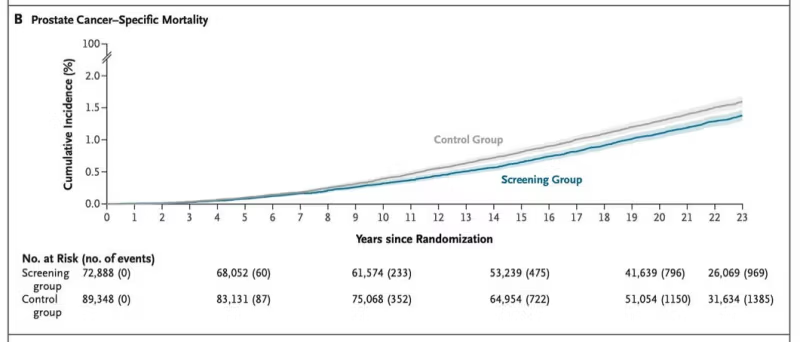
Men who were screened had a 13% lower risk of dying from prostate cancer than those who weren’t screened.

But that difference, while sounding impressive, shrinks dramatically when translated into absolute numbers: 1.4% versus 1.6%, an absolute reduction of 0.2% (see graph).

Prostate cancer mortality

That means you’d have to screen about 500 men to prevent one death from prostate cancer — the other 499 see no benefit.

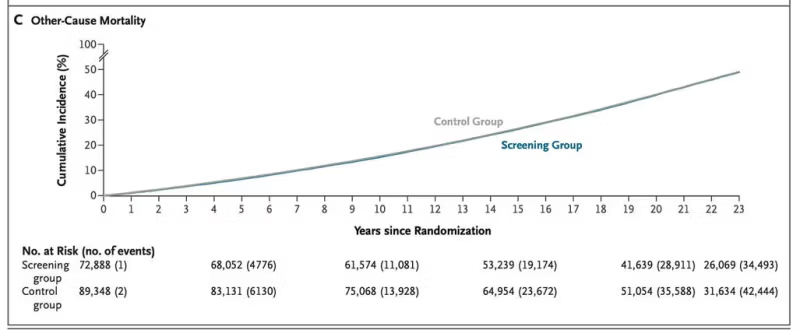
But here’s the key point — the overall death rates were identical in both groups (see graph below).

Despite finding more prostate cancers, men who were screened did not live longer — they simply had a higher chance of being labelled “cancer patients.”

Total deaths in both groups was indentical

The study found that while screening can modestly reduce prostate cancer deaths, it comes at the cost of significant overdiagnosis and overtreatment.

The reality for most men is that once a PSA test is positive, it’s almost impossible not to act.

At the Brownstone event, I described it like a conveyor belt: once you’re on it, it’s difficult to get off. An elevated PSA often sets in motion a chain of medical interventions that men may not need.

The Harms We Don’t Count

A positive test often triggers a chain reaction — MRIs, biopsies, surgery, radiation — and often with lifelong consequences.

Men who undergo unnecessary treatment can be left impotent, incontinent, or chronically anxious.

Most elevated PSAs are false positives, and even when biopsies reveal no cancer, the process itself carries risk — including infections that can require hospitalisation — and often leads to repeat testing and repeat biopsies.

The psychological toll — months of fear between tests, the dread of results, the pressure to “do something” can be harmful.

A recent study published in JAMA Internal Medicine of nearly a quarter-million US veterans found that even men with limited life expectancy — too old or frail to benefit — were being treated aggressively for prostate cancer.

The authors urged doctors to “avoid definitive treatment of men with limited life expectancy to prevent unnecessary toxic effects.”

It’s a roundabout way of saying what should be obvious — we’re hurting people we can’t help.

It’s often argued that today’s tests and treatments have improved, and while that may be true in some cases, the fundamental problem remains.

The Pressure to Participate

Every October brings Breast Cancer Awareness Month, urging women to get mammograms “for peace of mind.”

Every November brings Movember, encouraging men to grow moustaches to raise funds and promote prostate cancer screening in the name of “men’s health.”

The intentions are good. But these campaigns often create social pressure rather than informed choice. They send the message that screening is a no-brainer when, in fact, the evidence is far more nuanced.

Advocacy groups and celebrity endorsements can amplify that pressure, but they rarely explain the full picture: that for most men, prostate cancer is slow-growing and unlikely to be fatal.

Around 97% of men diagnosed with prostate cancer die from something else. For some, those are odds worth accepting.

Public health messaging tends to treat populations as uniform. But individuals aren’t.

Some men want every possible test and every possible intervention — and that is entirely valid. Others are comfortable with uncertainty, preferring to watch and wait rather than undergo treatment for something that might never cause harm.

Understanding what population-level recommendations mean for individual lives is essential.

Even Richard Ablin, the man who discovered the PSA test in 1970, later called mass screening “a public health disaster” in the New York Times, authoring an article titled “The Great Prostate Mistake.

At the Brownstone panel, I stressed the need for true informed consent — not just a pamphlet or checkbox, but an honest conversation between doctors and patients.

I’ve seen PSA tests ordered without patients even being aware — bundled into routine blood work for “general health” or “annual checkups.” Too often, the first time a man hears about PSA screening is after an abnormal result.

Patients must be asked whether they want the test — and whether they understand what a positive result could set in motion. They should know the risks of testing, the risks of not testing, and what living with uncertainty might look like.

For a man with a strong family history or someone who cannot live with uncertainty, PSA screening may be reasonable.

But for someone at peace with small risks and wishing to avoid procedures that may lead to impotence or incontinence, declining screening is equally rational.

This is what evidence-based medicine looks like — it takes into consideration a patient’s values and preferences, together with clinical experience and data.

The role of a doctor is to inform, not coerce.

Public health must stop selling certainty and start embracing nuance. Some abnormalities don’t need to be found. Sometimes in medicine, ‘less is more.’ And sometimes the most responsible medical decision is to do nothing.

The point is, it’s patients — not governments — who should steer their own medical decisions, once they’ve been fully informed.

The story of the PSA test, like routine mammography, reminds us that well-intentioned medicine can cause real harm when certainty is oversold and humility is lost.

Republished from the author’s Substack

Published under a Creative Commons Attribution 4.0 International License

For reprints, please set the canonical link back to the original Brownstone Institute Article and Author.

Author

  • Maryanne Demasi, 2023 Brownstone Fellow, is an investigative medical reporter with a PhD in rheumatology, who writes for online media and top tiered medical journals. For over a decade, she produced TV documentaries for the Australian Broadcasting Corporation (ABC) and has worked as a speechwriter and political advisor for the South Australian Science Minister.

------------------------
Source

https://brownstone.org/articles/the-prostate-cancer-test-dilemma/

Thursday, January 29, 2026

How The GOP Appropriators Bushwhacked The DOGE Boys

How The GOP Appropriators Bushwhacked The DOGE Boys

January 28, 2026

Hopefully, Elon Musk and his DOGE boys have learned a lesson the hard way. To wit, their earnest, dogged, sweeping and compelling demonstration early in 2025 that hundreds of billions can be cut from the Federal budget has already been shit-canned.

Almost in its entirety.

And by the usual suspects—-the GOP appropriators on Capitol Hill—who are the biggest fake fiscal conservatives to ever come down the pike.

Still more proof in the pudding is contained in the table below, especially the bottom three lines. These show total discretionary appropriations contained in the House passed funding bills for FY 2026 compared to levels previously signed into law by alleged Big Spending Dems—-that is, Biden’s outgoing bills for FY 2024 and Obama’s for FY 2017.

Of course, to hear the GOP pols tell it on the campaign trail and during their table-pounding appearances on Fox News, Joe Biden was the biggest spending miscreant to ever occupy the Oval Office. He was ostensibly the very reason that America needed a Republican Congress.

Then again, the discretionary spending level in the House GOP-approved bills for FY 2026 is $1.673 trillion. That is actually $5 billion higher than the alleged runaway spending contained in the Biden-signed appropriations for FY 2024!

And the culprit isn’t just the War Party’s defense spending increases, either. As shown in the second line from the bottom of the table, the House GOP’s appropriation for all domestic spending agencies in FY 2026 amounted to $764 billion, which was 98.6% of Biden’s ultra-bloated 2024 level ($775 billion).

That’s right. In aggregate terms the House GOP embraced the sky-high Biden domestic spending levels virtually hook, line and sinker. Moreover, the FY 2024 Biden levels themselves had represented a 7.5% increase from the hideously bloated $721 billion pandemic bailout levels of FY 2021. The latter spending explosion, of course, had been the joint product of the two Trump pandemic bailouts enacted in March and December 2020 and another one known as the American Rescue Plan Act from the incoming Biden Administration enacted halfway through the fiscal year in March 2021.

This FY 2021 UniParty spending bacchanalia, in turn, had represented a ripping 30% rise from Obama’s last domestic agency funding level for FY 2017 ($556 billion).

That’s right. Even if you had granted a 2% increases per year for inflation, the FY 2026 appropriations for domestic agencies would have amounted to $664 billion in order to keep the Obama priorities in tact and hold the FY 2017 levels harmless for inflation. So what the screaming hypocrites of the House GOP appropriations committee have actually done is to fully fund an inflation allowance for Obama’s priorities and then jacked-up the domestic appropriations by another $100 billion, to boot!

And, yes, we do mean to blame each and every GOP member of the House Appropriations Committee for this outrage. That’s because it is bad enough that the GOP members outside the appropriations committee voted 157 to 22 in favor of Speaker Johnson’s egregious capitulation to the Washington Swamp.

But what is truly obscene is that the GOP appropriations committee members voted 34 to 0 in favor of 2026 domestic spending levels in the January 8th minibus that make an absolute mockery of the DOGE boys. Indeed, these bloated domestic spending levels belie every speech these cats ever made in behalf of fiscal sanity—especially when they voted “yea” on the budget-buster called OBBBA, and did so on the grounds that they would get around to spending cuts right soon after the July 2025 signing ceremony.

As is now clear from the table below, they had no intention whatsoever of actually cutting spending—even as they whooped it up for another massive increase in red ink. The Big Beautiful Bill will actually hurtle the Federal budget on a path toward an economy- and society-crushing $185 trillion public debt by mid century.

Discretionary Appropriations Spending, FY 2017 to FY 2026

The above pitiful display of GOP fiscal mendacity, however, is nothing new. We encountered it front and center back in the day when the so-called GOP appropriators time and again did a rug pull on Ronald Reagan’s repeated efforts to actually shrink the Leviathan on the Potomac. Indeed, he had barely rode off into the sunset in 1989 when virtually every discretionary spending program which had been reduced in the initial enthusiasm of the 1981 budget cutting campaign had been fully restored and then some.

Needless to say, the name plates on the GOP side of the dais in the Appropriations Committee hearing room in the Rayburn Building have mostly changed, but the modus operandi remains exactly the same. That is to say, there is a reason why the vote of the GOP appropriators was 34-0 in favor of this monstrosity.

To wit, we are referring to the infamous appropriations committee process known as log-rolling: You vote for mine; I vote for yours; and we all vote for the final bill—no matter how condemnable the total price tag.

Since this venal sell-out by the appropriators is at the heart of the GOP’s long-standing fiscal capitulation to the Washington Swamp, the clear patterns in its $100 billion add-on to Obama’s domestic priorities needs to be thoroughly explicated. So doing , we will show exactly how this fiscal crime is committed over and over again, year after year.

So we start with the Transportation/HUD (or THUD) bill shown in the table above, where the Obama funding level was $57 billion as of FY 2017. Had Big Spender Obama’s funding level been kept even with inflation at about 2% per year, the funding level for 2026 would have been about $68 billion.

Alas, the GOP appropriators voted unanimously for the above indicated level of $102 billion for FY 2026. That is, they fully funded the Obama budget at an inflation hold-harmless level— and then added a staggering +$34 billion or 50% on top of that!

You can’t make this up. That’s especially because most of this excess was for housing rental subsidies and aid for the homeless!

For crying out loud, the means-tested entitlements for low income households already cost upwards of $1.3 trillion per year. Yet these bald-faced hypocrites, who are always saying that the problem is “entitlements”, not “discretionary” appropriations, actually added 50% to the inflation-adjusted Obama level for these latter programs, and then voted as a block on the House floor for their own deplorable handiwork.

In the case of what amounts to the Democrat political homeland at HHS, the story is hardly better. The plentiful Obama FY 2017 level was $79 billion—and, again, this was just for annually appropriated discretionary programs. The massive HHS entitlement programs for Social Security, Medicare/Medicaid/ObamaCare, SSI, family assistance etc., which currently cost more than $3 trillion per year, are not included in the table below.

Accordingly, with a 2% annual inflation make-whole, the HHS discretionary programs would have merited an appropriation of about $94 billion in FY 2026— if your purpose was to maintain Obama level social welfare spending in constant dollar terms. Most surely that should not have been the GOP’s purpose at all.

But the purported GOP anti-spenders, however, actually did the Obama legacy one better: The actual figure in the their minibus for FY 2026 was 15% higher at $108 billion.

That’s right. At the very ground zero of the Dem Welfare State boondoggles, the GOP appropriators chipped in an extra $13.6 billion in Barry’s honor, apparently.

Moreover, half of that extra was owing to the runaway budgets of the National Institutes of Health. As it happens, every disease known to man has a lobby deeply embedded in the Washington Swamp. These lobbies take ownership of each and every member of the Appropriations Committee—whether such Members ordinarily vote in a leftward or rightward direction or just in favor of the highest bidder.

Still, our figure of $40.6 billion as the inflation-adjusted Obama NIH budget for 2026 isn’t actually the half of it. Again, back in the day the FY 1980 budget for the NIH we inherited from Jimmy Carter was $3.6 billion, and it was clear even then that the funding level was loaded with fat, which we attempted to trim albeit to very little avail.

Yet had the Jimmy Carter budget for NIH been increased for inflation each and every year since then it would actually be $12 billion today, not our $40.6 billion keep-whole figure or most certainly not the GOP appropriators’ $48 billion. In a word, these fiscal fakers have authorized four times morefunding than would have been required to hold Jimmy Carter’s NIH budget harmless for inflation over the last 46 years!

Of course, it might be wondered whether there is a single Republican on the Appropriations Committee who has ever given any thought at all as to why the US government should be funding anything beyond basic science in the first place. As it is, the nearly $50 billion shoveled out through the NIH goes overwhelmingly for applied research, product development and proto-commercialization—measures which inure to the benefit of the fat and happy government-fed health care industry.

Indeed, have they ever wondered why the NIH breeds bureaucratic cretins the likes of Dr. Fauci?

No, rather than do their job as watchdogs of the Treasury, the GOP pols appointed to the Appropriations Committee end up functioning as concierges for the disease lobbies and the plenitude of other special interests who Fed at the Federal trough.

HHS Discretionary Spending, 2017 to 2026
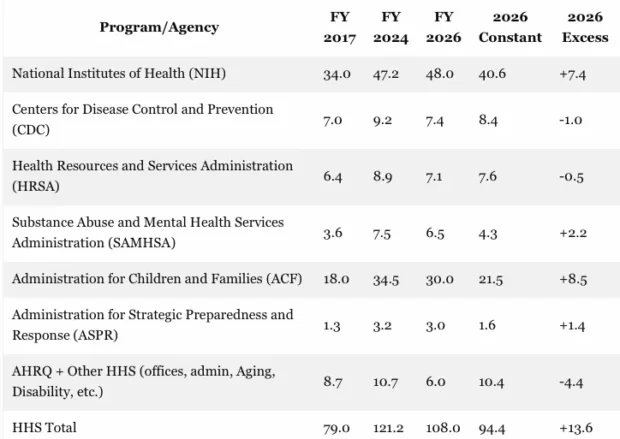
Notes:

  • Figures are base discretionary BA (excluding mandatory/trust fund and supplemental/emergencies).
  • FY 2017: From CRS R44070 and OMB Historical Tables.
  • FY 2024: From enacted P.L. 118-47 and House Appropriations summaries.
  • FY 2026: From House-passed H.R. 9027/minibus summaries (annualized; pending Senate and final enactment).
  • 2026 Constant = FY 2017 × (1.02)^9 ≈ FY 2017 × 1.195.

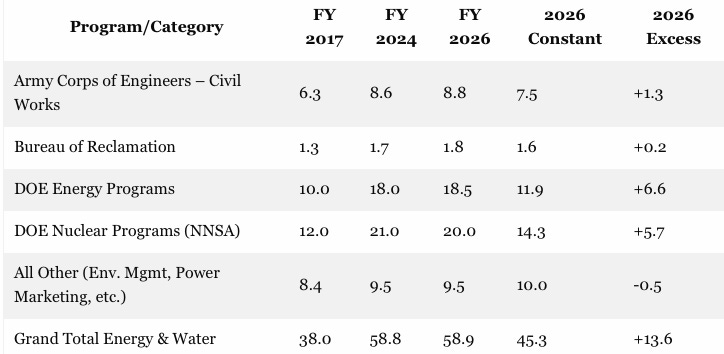
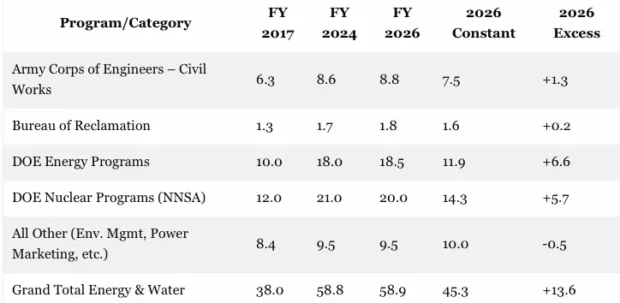
Needless to say, these kinds of pork barrels come in all sizes, shapes and budgetary domains. Thus, the Energy and Water bill for 2026 also contains funding way above the Obama level adjusted for inflation, providing 30% more or nearly +$14 billion of additional funding.

Again, the Federal government has no business using taxpayer funds or, worse still, borrowing money, to fund local river navigation improvements, flood plain control and energy R&D projects. Those are properly the business of private enterprise, local government or, at the least, should be funded 100% by user fees.

But when it comes to the pork barrel, it is a truism that energy subsidies and water projects grease the political wheels with alacrity on the banks of the Potomac. Indeed, we learned that early on as a freshman Congressman in 1977, when we got called to the White House by Jimmy Carter. In this case, he was actually trying to cut spending for egregiously wasteful and corrupt water projects, but was so desperate for any GOP support at all that he had to call upon a first termer for help on Capitol Hill.

The truth is, virtually none of the $59 billion appropriated for 2026 can be justified in the face of a $38 trillion public debt that is rapidly rising skyward. Indeed, even the $20 billion for the DOE nuclear programs could be readily squeezed out of the massive fat in the Pentagon budget.

But have the GOP appropriators ever even thought about actually defunding the DOE, the Army Corps of Engineers and the Bureau of Reclamation? With their noses firmly implanted in the trough, we are quite sure the thought has never even crossed their minds.

Discretionary Appropriations For Energy And Water, 2017-2026
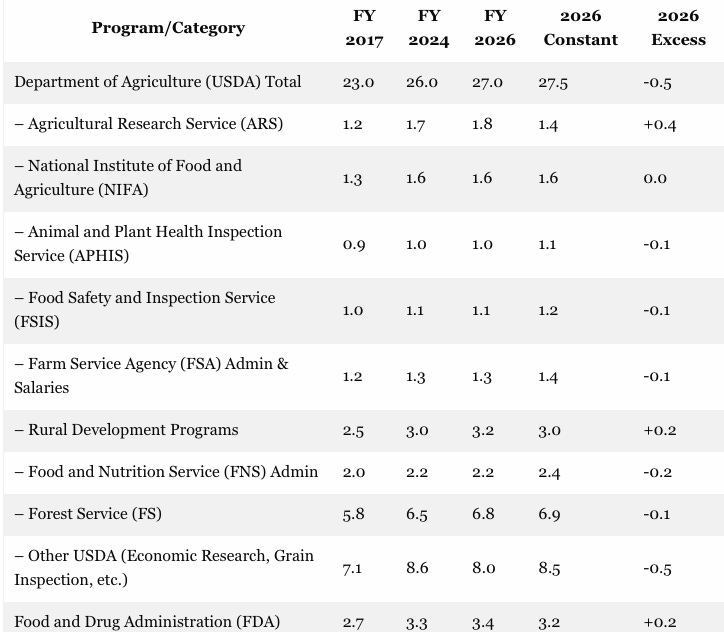
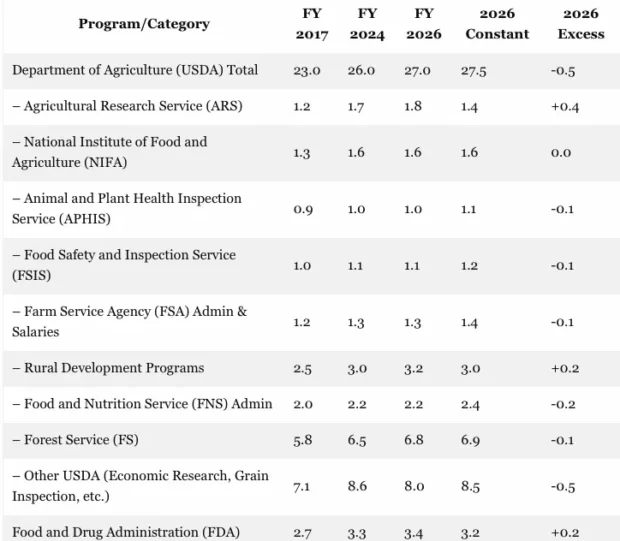
In the case of the $30.4 billion FY 2026 funding for the Agriculture bill, it can be at least said that this level is about equal to the Obama FY 2017 budget adjusted for inflation. But here’s the thing: More than 90% of this total shouldn’t even be funded.

To wit, the food inspection, FDA and other regulatory operations should be funded by user fees or drastically reduced in scope. Likewise, ag research, rural development and the Forest Service should be largely privatized.

Then again, farm state Republicans get on the Appropriations Committee and the relevant subcommittees precisely to insure no free market Republican or libertarian bomb-thrower even gets in the vicinity of the Appropriations Committee hearing room. After all, the idea of defunding this entire trough of pork might sound exactly like there own speeches in favor of free enterprise and fiscal rectitude back on the campaign trail.

Discrimination Funding In The Agriculture Bill, 2017 to 2026
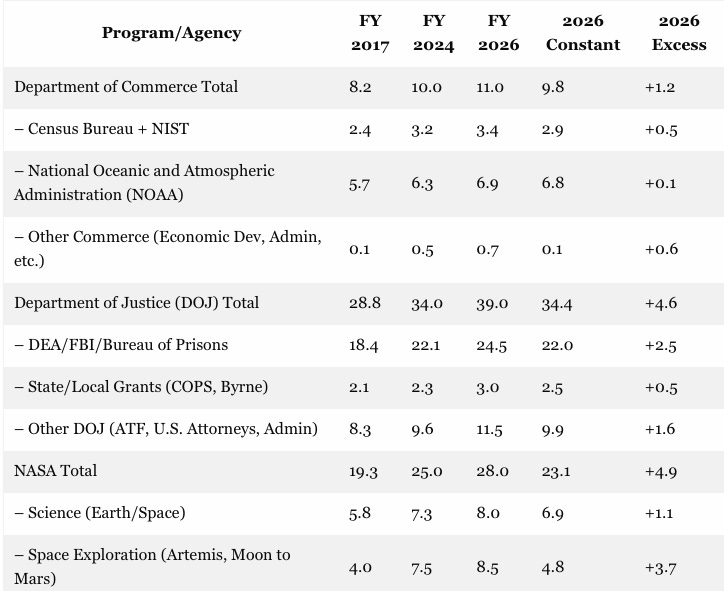
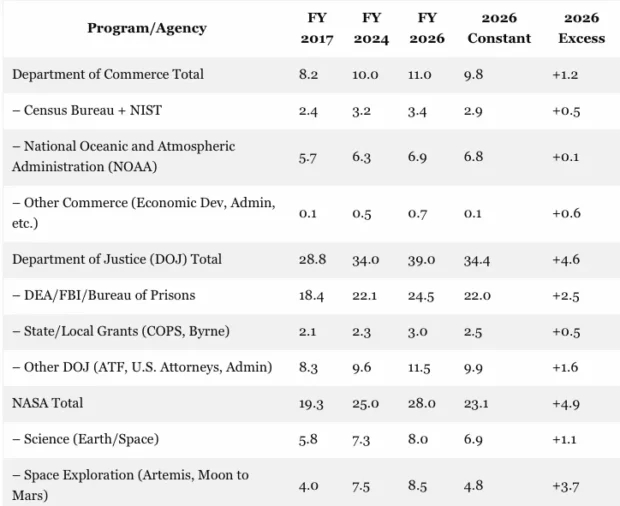
The same can surely be said for the $78 billion provided for FY 2026 in the Commerce/Justice Science bill. Again, this represent a 16% or $11 billion increase to the Obama levels in real terms, but that’s not even the half of it.

To wit, in a world of small, decentralized, solvent government upwards of $60 billion or 80% of this amount could actually be cut from the proposed 2026 figure. And that could start with eliminating the entire $28 billion appropriation for NASA.

If space launches have a military purpose, they should be funded by the Pentagon. If they have a commercial purpose like some of the Space X ventures, they should be funded by the private sector and satellite users. And if they are for the thrill and adventure of exploring the universe they should be funded by private space buffs—-from Elon Musk to the guy with a backyard telescope.

To the contrary, NASA never has been a legitimate government project, even when it sent a man to the moon in 1969 at massive taxpayer expense, and then forgot all about it for the next 55 years. The moon-landing was always a silly national vanity project that Washington fell for in the early 1960s because we didn’t get a dog, and then a man, up in low earth orbit before the Ruuskies did. That is, before a communist system that was destined to fail could waste more money than Washington could.

The same goes for the Commerce Department’s $11.0 billion appropriation. NOAA should be funded by users who actually are willing to pay for weather reports and atmospheric research or not be done at all. Ditto for most of the $9 billion appropriated to the National Science Foundation: Cut it back to basic science and let the rest find a home in the private sector, if there is one.

Even in the case of the $39 billion appropriated to DOJ, the overwhelming share ($25.4 billion) goes to the FBI/DEA and Bureau of Prisons. The fact is, the War on Drugs is a grotesque failure–so the DEA should be defunded and abolished.

Likewise, enforcement of the criminal laws in our constitutionally ordained Federalist system is overwhelmingly a proper function for the 86,000 units of state, county, city, village and township government in the US. The FBI’s $12 billion budget and 35,000 headcount could be cut by 80%, and law and order in the America would be no worse for the wear.

To the contrary, it would actually result in far less false flag spooking of the public by the FBI’s endless entrapment operations designed to create the illusion that America is being over-run by terrorists and foreign agents.

And as for the Bureau of Prison (BOP), get rid of the drug prohibition prisoners, others prosecuted for so-called morality crimes and white collar offenses and most of the inmates nabbed in phony counter-terrorist operations. You then wouldn’t need 80% of the cells and most of the BOP’s $10 billion budget.

Commerce/Justice/Science Appropriations, FY 2017 to FY 2026
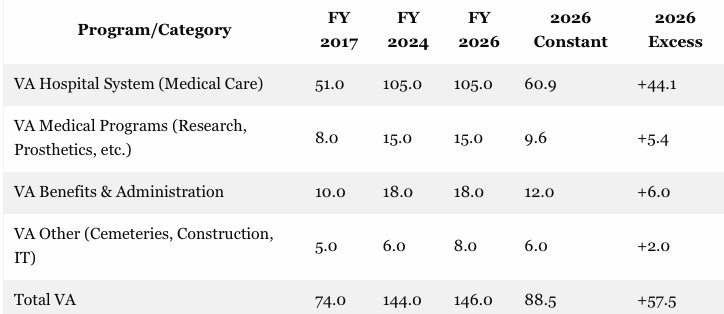
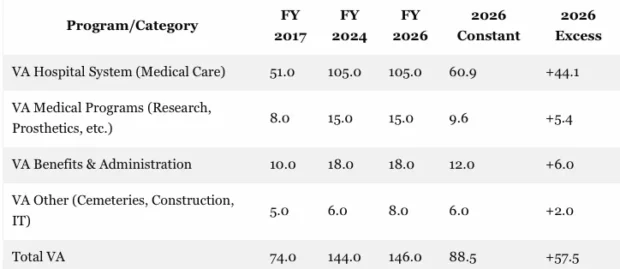
Finally, we have the real elephant in the room. We are referring to Obama’s $74 billion 2017 budget for discretionary Veterans Administration (VA) programs, which would be nearly $89 billion in FY 2026 if it had been fully funded for inflation.

Alas, the GOP appropriators provided $146 billion for FY 2026 or $58 billion more than the inflation-adjusted Obama budget. So you might think that there has been a flood of new VA beneficiaries since 2017, but you’d be wrong.

What we actually have is the travesty of 17 million veterans of the totally unnecessary Forever Wars (there are only a few thousand WWII vets left) who are eligible for the full range of health and mental health benefits, but which are delivered by a government bureaucracy that gives the very idea of waste, excess, feather-bedding and grotesque inefficiency a wholly new definition.

For instance, there are 70,000 beds in the VA hospital system that are normally 65% to 70% occupied, meaning an average census of about 49,000 patients. But the VA hospital system has 295,000 employees, which amounts to more than six VA staff for every patient!

So were the VA hospital systems employees to all be put into occupied rooms, there would literally be standing room only.

Likewise, in the case of the VA benefits administration the overhead cost of $18 billion amounts to 2.3% of compensation and pension benefits paid. That’s an admin cost ratio which is 3X higher than the Social Security Administration’s o.7% ratio, which is no paragon of efficiency, either.

The larger point is that the GOP appropriators are wholly-controlled water-boys for the various veterans organizations and their powerful beltway lobbies. Consequently, the screaming fiscal disgrace of the $146 billion VA budget is directly attributable to GOP appropriators who have never been interested in the slightest in bringing this budgetary monster to heel.

Veterans Administration Discretionary Spending, FY 2017 t0 FY 2026
Notes:

  • VA Hospital System (Medical Care): Primarily the Veterans Health Administration’s medical care account (direct hospital and outpatient services).
  • VA Medical Programs: Includes medical research, prosthetics, medical facilities support, and related medical R&D.
  • VA Benefits & Administration: Covers compensation/pension, education, vocational rehab, and administrative costs for benefits delivery.
  • VA Other: Includes national cemeteries, construction, IT systems, and general administration.
  • FY 2017: From CRS R44070 and OMB Historical Tables.
  • FY 2024: From enacted P.L. 118-47 and House Appropriations summaries.
  • FY 2026: From House-passed minibus summaries (annualized; pending Senate and final enactment).
  • 2026 Constant = FY 2017 × (1.02)^9 ≈ FY 2017 × 1.195.

Indeed, if there were ever an agency that needed a DOGE-style housecleaning, it is surely the VA. But in Clint Eastwood style, as it were, the GOP appropriators have already pronounced their perennial verdict: Don’t even think about it!

Finally, we would be remiss if we did not conclude this review with the names of the 34 GOP miscreants who produced this condemnable monstrosity. So here they are—-every last one of the names truly fit for the Wall of Fiscal Shame.

Elon Musk and the DOGE boys gave them a road map on how to save the hundreds of billions that all along they have been too lazy and too compromised to find. But 12 months later there is not even a teeny-tiny sign in the FY 2026 funding bills that the DOGE boys ever came to town.

Appropriations Committee Republicans (34 members, including Chair Tom Cole (R-OK), Hal Rogers (R-KY), Robert Aderholt (R-AL), Michael Simpson (ID), John Carter (TX), Ken Calvert (CA), Mario Diaz-Balart (FL), Steve Womack (AR), Chuck Fleischmann (TN), David Joyce (OH), Andy Harris (MD), Mark Amodei (NV), Dave Valadao (CA), Dan Newhouse (WA), John Rutherford (FL), Julia Letlow (LA), Guy Reschenthaler (PA), Ashley Hinson (IA), Tony Gonzales (TX), Ben Cline (VA), Scott Franklin (FL), Jake Ellzey (TX), Juan Ciscomani (AZ), Michael Guest (MS), Andrew Clyde (GA), Jake LaTurner (KS), Jerry Carl (AL), Stephanie Bice (OK), Dusty Johnson (SD), Amata Coleman Radewagen (AS), Mark Alford (MO), Nick LaLota (NY), Dale Strong (AL), Celeste Maloy (UT), Riley Moore (WV)): 34 Yea, 0 Nay.

Reprinted with permission from David Stockman’s Contra Corner.

Copyright © David Stockman

The Best of David Stockman

Former Congressman David A. Stockman was Reagan's OMB director, which he wrote about in his best-selling book, The Triumph of Politics. His latest books are The Great Deformation: The Corruption of Capitalism in America and Peak Trump: The Undrainable Swamp And The Fantasy Of MAGA. He's the editor and publisher of the new David Stockman's Contra Corner. He was an original partner in the Blackstone Group, and reads LRC the first thing every morning.
--------------------------------
Source
https://www.lewrockwell.com/2026/01/david-stockman/how-the-gop-appropriators-bushwhacked-the-doge-boys/

Monday, January 26, 2026

Everything you need to know about BlackRock, the company that owns the world

Everything you need to know about BlackRock, the company that owns the world

(LifeSiteNews) — BlackRock is one of the most powerful organizations in the world, and its nefarious role in global economics and politics is becoming more apparent.

The investment giant is pushing woke politics in the form of corporate social credit scores (ESG), which includes the dangerous “net zero” and LGBT agenda. BlackRock is also responsible for rigging the financial systems and has control over a significant portion of the world’s wealth.

In order to fight back, we need to know what we are dealing with. In this article, we take a deep dive into the history, current business practices, and plans of the globalist behemoth known as BlackRock.

The history of BlackRock and its founder

As of early 2022, BlackRock Inc. had around $10 trillion in assets under its management, making it the largest asset manager in the world. Blackrock holds a significant number of shares in most of the largest corporations in the world, including Amazon, Apple, Microsoft, Google, Tesla, Coca-Cola, Moderna, Johnson & Johnson, Exxon Mobil, Visa, Chevron, JPMorgan Chase, Walmart, and many more.

The company was founded 35 years ago, in 1988, by investment banker and current CEO Larry Fink as an affiliate organization of Blackstone Inc. It was originally named Blackstone Financial Management and grew rapidly within the first four years of its existence, reaching a portfolio of $17 billion by 1992, journalist James Corbett reported.

Since BlackRock had grown into a very respectable business, Fink and Stephen Schwarzman, the CEO of Blackstone, decided to separate BlackRock from Blackstone and make it into its own venture.

BlackRock went public in 1999 for $14 a share; the firm managed $165 billion in assets at this point. In the early 2000s, the company expanded its business to include analytics and risk management. It bought the investment management company State Street Research & Management in 2004, merged with the investment management firm Merrill Lynch in 2006, and acquired the Quellos Group’s key asset-management unit in 2007, bringing BlackRock’s total asset value under management to over $1 trillion.

While the financial success of BlackRock may seem impressive up until this point, what really turned the firm into the global financial dominator it is today was the financial crisis of 2007 and 2008. Journalist Heike Buchter, who wrote a book on BlackRock, said in 2015, “Prior to the financial crisis I was not even familiar with the name. But in the years after the Lehman [Brothers] collapse [in 2008], BlackRock appeared everywhere. Everywhere!”

Fink was trusted by these institutions as an expert on the financial instruments that led to the sub-prime mortgage crisis because he helped to create the toxic mortgage industry. In the 1980s, when Fink was still working for the investment bank First Boston, he constructed “his first Collateralized Mortgage Obligation (CMO) and almost single-handedly” created “the sub-prime mortgage market that would fail so spectacularly in 2008,” Corbett wrote.

“When the dust finally settled on Wall Street after the Lehman Brothers collapse, there was little doubt who was sitting on top of the dust pile: BlackRock,” Corbett said.

Under Fink’s leadership, BlackRock used its financial power and influence to move into national and international politics. Author and economic journalist F. William Endgahl put it this way:

BlackRock founder and CEO Larry Fink is clearly interested in buying influence globally. He made former German CDU MP Friederich Merz head of BlackRock Germany when it looked as if he might succeed Chancellor Merkel, and former British Chancellor of Exchequer George Osborne as ‘political consultant.’ Fink named former Hillary Clinton Chief of Staff Cheryl Mills to the BlackRock board when it seemed certain Hillary would soon be in the White House.

He has named former central bankers to his board and gone on to secure lucrative contracts with their former institutions. Stanley Fisher, former head of the Bank of Israel and also later Vice Chairman of the Federal Reserve, is now Senior Adviser at BlackRock. Philipp Hildebrand, former Swiss National Bank president, is vice chairman at BlackRock, where he oversees the BlackRock Investment Institute. Jean Boivin, the former deputy governor of the Bank of Canada, is the global head of research at BlackRock’s investment institute.

You can clearly see the entanglement between BlackRock and the highest levels of politics and business and the immense global influence Fink’s investment firm therefore possesses. The corporation became so powerful that Professor William Birdthistle called it the “fourth branch of government.”

BlackRock in cahoots with the Biden administration

In 2019, when Joe Biden contemplated running for President against Donald Trump, the former vice president met with Fink to ask for BlackRock’s support. The CEO reportedly told Biden that “I’m here to help.”

Biden, seemingly quick to compensate BlackRock for its help, appointed Brian Deese as director of the National Economic Council soon after he became President. Before that, Deese was BlackRock’s Head of Sustainable Investing from 2017 until 2020. He also held several key positions in the Obama administration, including senior adviser to the president.

Another former BlackRock employee in the current Biden administration is Deputy Treasury Secretary Adewale Adeyemo, who served as senior adviser to Fink from 2017 until 2019. The Nigerian-born politician also has close ties to former President Barack Obama; he was chosen to be the first president of the Obama Foundation in 2019.

Moreover, former global chief investment strategist at BlackRock, Michael Pyle, is now the senior economic adviser to Vice President Kamala Harris. Pyle also served as a senior adviser to the Undersecretary of the Treasury for International Affairs in the Obama administration.

One may say that the Biden administration’s economic policy is essentially run by BlackRock.

BlackRock’s key role in the Great Reset and the COVID ‘pandemic’

Corbett argues that the COVID-19 “pandemic” was not mainly about a virus but rather represented an opportunity for global elites, particularly BlackRock, to reshape the global economy and the financial system.

On August 22, 2019, Fink officially joined forces with Klaus Schwab’s globalist World Economic Forum (WEF) when he became a member of the WEF’s Board of Trustees. On the same day, a meeting began of central bankers, economists, and policymakers to discuss economic policy – the annual Jackson Hole Economic Symposium – where BlackRock kicked off its financial revolution.

One week before the event, BlackRock published a paper that would set the parameters of the discussion at the symposium in Jackson Hole, Wyoming.

“After years of quantitative easing (QE) and ZIRP (zero interest rate policy) and even the once-unthinkable NIRP (negative interest rate policy), the banksters were running out of room to operate,” Corbett explained.

So, the financial elites needed something new and BlackRock provided them with an answer: “Going direct.”

In order to understand the concept, one must first know that the monetary system is split into two circuits: the retail circuit and the wholesale circuit. The retail circuit is where “bank money” is spent, i.e. the money that regular people and businesses spent to transact in the economy. Then there is “reserve money” (wholesale circuit) which are the deposits that banks keep at central banks, like the Federal Reserve (Fed) or the European Central Bank (ECB).

For a more detailed explanation of the two monetary circuits, you can read my article on Central Bank Digital Currencies.

BlackRock’s proposal of “going direct” meant bypassing the split monetary system and letting central banks directly pump money into various private and public entities.

“An unprecedented response is needed when monetary policy is exhausted and fiscal policy alone is not enough,” BlackRock’s August 2019 paper stated. “That response will likely involve ‘going direct’: Going direct means the central bank finding ways to get central bank money directly in the hands of public and private sector spenders.”

In September 2019, months before the so-called “pandemic” began, Federal Reserve money started to be directly pumped into the retail monetary circuit.

Once the federal bailouts began with the first lockdowns in March 2020, the “going direct” system had already been put in place and the Fed could directly put money into private and public organizations.

“What we were told was a ‘pandemic’ was in fact, on the financial level, just an excuse for an absolutely unprecedented pumping of trillions of dollars from the Fed directly into the economy,” Corbett wrote.

In March 2020, similar to the financial crisis in 2007–2008, the Fed turned to BlackRock to manage its bailout programs.

This allowed BlackRock to get access to government, i.e. taxpayer, money, and distribute it to corporations that BlackRock was invested in and it enabled BlackRock to bail out one of its most important assets: iShares, the exchange traded funds (ETFs) collection, which as of January 2023 had $2.23 trillion worth of assets under management.

This means that BlackRock was allowed by the Fed to use taxpayer money to bail out its own assets. Russ and Pam Martens put it like this in their blog piece:

No bid contracts and buying up your own products, what could possibly be wrong with that? To make matters even more egregious, the stimulus bill known as the CARES Act set aside $454 billion of taxpayers’ money to eat the losses in the bail out programs set up by the Fed. A total of $75 billion has been allocated to eat losses in the corporate bond-buying programs being managed by BlackRock. Since BlackRock is allowed to buy up its own ETFs, this means that taxpayers will be eating losses that might otherwise accrue to billionaire Larry Fink’s company and investors.

In addition to the Fed, the Bank of Canada and the Swedish central bank also consulted BlackRock to help manage their corporate bond buying program.

With its 2020 “going direct” coup d’état, “BlackRock had truly conquered the planet,” Corbett wrote.

“It was now dictating central bank interventions and then acting in every conceivable role and in direct violation of conflict-of-interest rules, acting as consultant and advisor, as manager, as buyer, as seller and as investor with both the Fed and the very banks, corporations, pension funds and other entities it was bailing out.”

BlackRock’s all-powerful IT system

A significant portion of the value of all stocks and bonds in the world is managed through BlackRock’s “central processing system for investment management.”

This system, called Aladdin (abbreviation for “asset, liability, debt and derivative investment network”), is not only used by BlackRock itself.

BlackRock Solutions, one of BlackRock’s subsidiaries, licenses Aladdin to over 150 institutions, including the second largest asset manager in the world, Vanguard, and another giant of the industry: State Street Global Advisors. The system is also used by many of biggest insurance companies in the world and Big Tech firms such as Alphabet (Google), Apple, and Microsoft, as well as multiple pension funds.

Every day, Aladdin runs so-called “Monte Carlo simulations” – computer algorithms designed to model the probability of possible outcomes in systems that contain random variables – on all of the financial instruments under its management.

In 2017, Aladdin was risk-managing assets worth $20 trillion, the Financial Times reported. BlackRock has stopped reporting this figure since then, and it is likely much higher today.

In the past, the IT system was only used to calculate risk while the decisions were still made by humans. However, in 2017, Fink “threw his lot in with the machines” as BlackRock started to use an automated computer system called “Monarch” that took over the decision-making process for many of its assets.

In short, BlackRock’s Aladdin system manages well over $20 trillion worth of assets, which means that a considerable portion of the world’s wealth is dependent on calculations of a single computer system. Moreover, decisions to buy and sell stock are increasingly made by algorithms and AI instead of human beings.

Mistakes in the algorithms, whether they are deliberate or not, could therefore result in a disaster for the world economy.

The burning question that remains is what BlackRock plans to do with all the immense power and influence it acquired.

How BlackRock controls the world

“Behaviors are going to have to change and this is one thing that we are asking companies. You have to force behaviors and at BlackRock, we are forcing behaviors.”

This Larry Fink quote from 2017 summarizes what BlackRock is doing with its power and influence: forcing behaviors and shaping society in its image.

Fink’s yearly “letter to CEOs,” although it is officially not a directive, has been described as a “call to action” that changes the corporate behavior of many of the largest companies in the world. This was even confirmed by a peer-reviewed paper that concluded that “our evidence suggests that portfolio firms are responsive to BlackRock’s public engagement efforts.”

Fink has been using his influence over the corporate world to push the woke Environmental, Social, and Governance (ESG) agenda. ESG is essentially a kind of social credit system for corporations to make sure that they toe the line on destructive “net zero” carbon emission policies and various other items of the globalist agenda.

READ: DeSantis leads coalition of 19 governors to oppose ‘woke’ corporate ESG ideology

In his 2022 letter to CEOs, Fink wrote the following:

Sustainable investments have now reached $4 trillion. Actions and ambitions towards decarbonization have also increased. This is just the beginning – the tectonic shift towards sustainable investing is still accelerating. Whether it is capital being deployed into new ventures focused on energy innovation, or capital transferring from traditional indexes into more customized portfolios and products, we will see more money in motion.

Every company and every industry will be transformed by the transition to a net zero world. The question is, will you lead, or will you be led?

He also made it clear that BlackRock demands that corporations follow the “net zero” ESG agenda:

Stakeholder capitalism is all about delivering long-term, durable returns for shareholders. And transparency around your company’s planning for a net zero world is an important element of that. But it’s just one of many disclosures we and other investors ask companies to make. As stewards of our clients’ capital, we ask businesses to demonstrate how they’re going to deliver on their responsibility to shareholders, including through sound environmental, social, and governance practices and policies.

A low ESG “social credit” rating will prevent business from successfully operating, as journalist Iain Davis explains:

This will be achieved using Stakeholder Capitalism Metrics. Assets will be rated using environmental, social and governance (ESG) benchmarks for sustainable business performance. Any business requiring market finance, perhaps through issuing climate bonds, or maybe green bonds for European ventures, will need those bonds to have a healthy ESG rating.

A low ESG rating will deter investors, preventing a project or business venture from getting off the ground. A high ESG rating will see investors rush to put their money in projects that are backed by international agreements.

BlackRock is not alone in pushing the net zero agenda. There are currently 301 signatories to “The Net Zero Asset Managers initiative” that combined have $59 trillion under management.

Naturally, BlackRock also promotes Central Bank Digital Currency (CBDC), as the complete digitization of payments would enable total control over all monetary exchanges and therefore make it even easier to enforce the ESG agenda.

In his 2022 letter to shareholders, Fink raved about the benefits of CBDCs like “reducing the risk of money laundering and corruption” and bringing “down costs of cross-border payments.”

It goes almost without saying that BlackRock also pushes the LGBT agenda by promoting the so-called Corporate Equality Index, which rates companies’ commitment to “LGBTQ-inclusive policies and practices.”  The index is published by the Human Rights Campaign, an organization funded by George Soros’ Open Society Foundation.

Journalist James Corbett paints a bleak picture of the future that BlackRock envisions:

 The future of the world according to BlackRock is now coming fully into view. It is a world in which unaccountable computer learning algorithms automatically direct investments of the world’s largest institutions into the coffers of those who play ball with the demands of Fink and his fellow travellers. It is a world in which transactions will be increasingly digital, with every transaction being data mined for the financial benefit of the algorithmic overlords at BlackRock. And it is a world in which corporations that refuse to go along with the agenda will be ESG de-ranked into oblivion and individuals who present resistance will have their CBDC wallets shut off.

Hope for a better future

BlackRock may seem like an unstoppable force by now, but until recently the majority of the public had no idea who BlackRock even was or what they are doing. This is changing before our eyes.

The pushback against BlackRock and its agenda has been growing in recent years, with protests taking place at their New York and Paris offices.

Moreover, the nonprofit organization Consumers’ Research launched a campaign against BlackRock last year, criticizing the firm for its China connections.

“You’d think a company that has made it their mission to enforce ESG (environmental, social and governance) standards on American businesses would apply those same standards to foreign investments, but BlackRock isn’t pushing its woke agenda on China or Russia,” the executive director of Consumers’ Research said. “America’s consumers know a liar when they see one, and Consumers’ Research isn’t going to let them get away with it.”

The resistance from states governed by Republicans has also been growing. Florida Gov. Ron DeSantis recently pulled $2 billion from BlackRock’s treasury fund. Louisiana and South Carolina have announced that they will withdraw state funds from BlackRock as well, and Arkansas has already taken $125 million out of accounts managed by BlackRock. DeSantis is also leading a coalition of 19 governors to oppose the woke corporate ESG agenda.

At the latest Conservative Political Action Conference (CPAC), a panel discussion was held titled “The New Axis of Evil: Soros, Schwab, and Fink,” which focused on the ability of wealthy elites, including BlackRock, to force far-left policies upon the United States and around the world.

By spreading information about BlackRock’s nefarious plans and actions, public opinion can change and Fink’s corporate behemoth will be put under pressure. The economic collapse that is likely to occur in the near future will have people looking for those responsible for the crisis – and BlackRock is certainly among the perpetrators. It remains to be seen whether or not BlackRock is going to be able to retain its power and influence now that it will be in the spotlight and public opinion is turning on them.

-------------------

Andreas Wailzer is an Austrian journalist based in Vienna writing for LifeSiteNews. He studied business and economics in Vienna and Vancouver, Canada. In 2022, he left his job in the corporate world to work full-time in the field of Catholic journalism and advocacy, first at the St. Boniface Institute in Vienna and now at LifeSiteNews.

Andreas loves to write about politics, economics, and everything related to the Catholic faith. His work has been published in English and German in multiple media outlets, including Die Tagespost, Wochenblick, Corrigenda, and LifeSiteNews.

-----------------------------

Source

https://www.lifesitenews.com/blogs/everything-you-need-to-know-about-blackrock-the-company-that-owns-the-world/

Mundane Astrology...The significance of transiting Uranus, Neptune, and Pluto when they Station

Mundane Astrology...The significance of transiting  Uranus, Neptune, and Pluto when they Station In mundane astrology—which focuses on world...