Anthony Fauci’s Private Diary and Emails Show He Knew Lockdowns Failed
Fauci was portrayed, starting in early 2020, as an objective, brilliant, virtually infallible God-like figure.
He was the voice of opposition to President Donald Trump, a clear-eyed force of evidence-driven policy, contrasting with the evil Trump who didn’t “listen to the science.”
That’s not an exaggeration; there were Christmas tree ornaments made depicting Fauci as a Pope, there were shrines put up in people’s houses, he was on the cover of various magazines, and he was given a parade of endless, relentlessly glowing media appearances from his fawning, adoring fans. Fans like CNN’s Jake Tapper and Dana Bash.
For most critics it was clear almost immediately that these portrayals and friendly media appearances depicted the exact opposite of reality.
Fauci was a narcissist. Someone who enjoyed the attention, power, and influence he now unexpectedly wielded. He was unimaginably arrogant, unwilling to listen to new evidence if it contradicted what he wanted to believe, as well as someone who apparently thought himself a virtually infallible, God-like figure.
Well, Sen. Rand Paul (R-KY) over the weekend released a series of diary entries, emails, and inside information from Fauci himself and it turns out that the critics were more dead on than they could have ever imagined.
There are so many humiliating, embarrassing, discrediting revelations from the emails and diary entries that many are still compiling them. Combing through the list of statements that he made privately, in direct contradiction to his public pronouncements, could be a full time job. For weeks.
But let’s highlight a few, revisit what he said, and explain what it all means.
One of Fauci’s most heinous legacies was the strong push for lockdowns, school closures, and mask mandates. Those three policies were and remain significant contributors to many of the negative outcomes resulting from our response to the Covid pandemic.
School closures set back an entire generation of children.
Lockdowns led to governments printing money to allow people to stay home, setting off a spiral of runaway inflation that is still not under control.
And masks permanently damaged millions of people, from schoolchildren forced to wear them, to hospital workers who are now indefinitely required to mask in healthcare settings unnecessarily, or for those who continue to mask out of irrational fear and effective propaganda.
Many of these policies can be traced directly back to Anthony Fauci. And now we have proof of just how inept and incompetent his recommendations were, and how dishonest he was, as it became clear he’d failed.
Here’s one example. In an email to Deborah Birx, another key architect of our failed response, Fauci unwittingly admitted that he was aware lockdowns and closures did not impact the spread of Covid.
“I have been obsessing about the increases in cases that do not seem to be related to openings or closings or massive crowds,” he wrote. “I believe that ultimately we will see increases related to all of the above; however, right now we may be looking for the lost keys under the light of the lamppost. There is something inherent here that we are missing and that is insidiously keeping the outbreak alive in the USA, and that is more concerning than anticipated spikes associated with identifiable events.”
Surely, this email was written in 2021 or 2022, right? After closures and lockdowns became less common?
Nope. June 18, 2020. That’s just a few months after the initial shutdowns. He knew in June 2020 that closures did not lead to increases in cases, and for quite literally years afterward, he demanded closures and shutdowns continue.
He criticized Florida Gov. Ron DeSantis for reopening his state, months later. In September, for example, he said Florida was “asking for trouble” by opening. Three months after he was fully aware, and admitted privately, that closures had no impact on the spread of the virus. Indefensible.
What about masks? Here’s another email from April 15, 2020, less than two weeks after the CDC abandoned science and recommended public masking out of panic.
Apparently the White House, or then-Vice President Mike Pence did not fully support masks, and Fauci and Birx once again got involved.
“We should push back a bit on the masks. I think that it is important. Since when do comms people dictate public health suggestions? Walk out of the streets and people are wearing them anyway,” Fauci wrote. “We should be on board with them. I would be happy to do that tomorrow. We are meeting with the VP tomorrow morning. Can you arrange for you and I to meet with the relevant person so I can give it a pitch?”
No new evidence. No studies to reference. No peer-review. No data. Just, “people are wearing them anyway” and “we should be on board” with the CDC. That’s how Fauci decided to push one of the most important and harmful “interventions” of the pandemic. Because everyone else was doing it too.
Then there’s the lab leak.
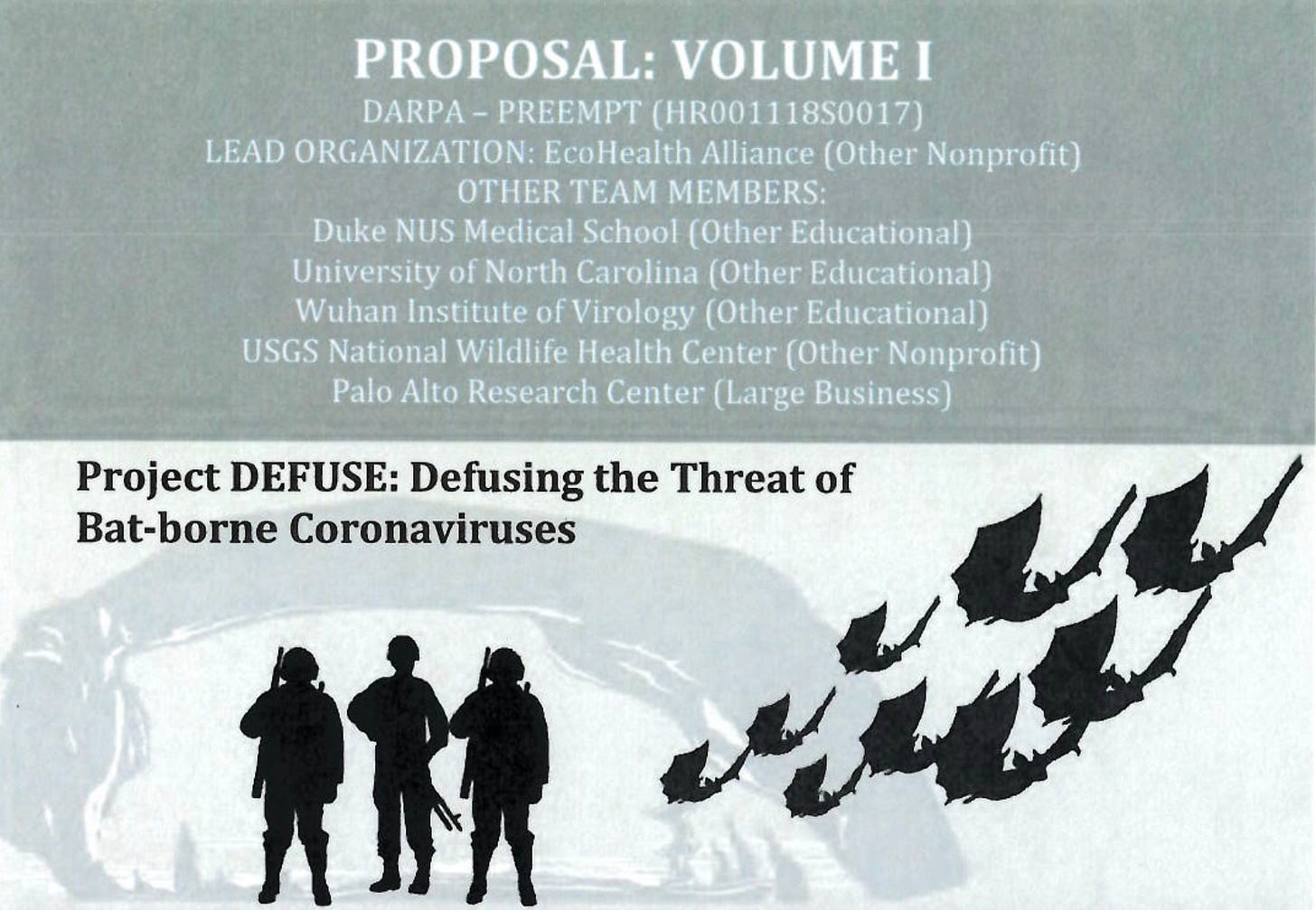
By now it’s widely accepted that the lab leak is the most likely explanation for the origin of Covid. The Wuhan Institute of Virology proposed doing exactly the type of gain-of-function research that could have led to the creation of an enhanced virus, and did not have proper safety protocols for the work they were doing. As just one example.
Early on in the pandemic, however, the forces of institutional science came together to tell the public that a lab leak was a conspiracy theory. The Wuhan wet market was the source, they said, of a naturally occurring virus. They had no evidence for this suggestion, only speculation and the wish to avoid scrutiny of their profession with the hope of avoiding a decrease in funding.
One pivotal moment in the early weeks of the pandemic was a phone call with 12 subject matter experts where they discussed their opinions on a natural vs lab origin.
For years, the contents of this call were mostly hidden. Not anymore.
“There was not total agreement about the likelihood of deliberate insertion,” Fauci’s diary entry from 2020 explained. “Ron Fouchier said he was sure that this could occur naturally and we should not waste our time and divert effort to pursue this. This is expected of him since he was the original GOF person with Yoshi Kawaoka. Also, Christian Drosten was with Ron; the rest felt that deliberate insertion was possible and given the fact that Dr. Zheng-Li Shi at the University of Wuhan has been working for years in GOF in coronaviruses to allow adaptation of the spike protein to bind to the human ACE2 receptor…”
So a prominent gain-of-function advocate believed it was natural, of course, along with one other scientist. The other 10? They believed that “deliberate insertion was possible” and potentially even likely, given they knew that scientists in Wuhan had long been doing this exact type of work. Surely, then, those scientists came forward to say a lab leak was possible…right?
Of course not. They did the opposite, to avoid scrutiny, criticism, and funding loss, then deliberately misled the public for years afterwards to cover it up. Fantastic.
Fauci’s diary entries are littered with descriptions of his media appearances, excitement, and joy that his fame and public profile had risen. He realized quickly that the mortality rate from Covid was significantly lower than most public estimates, then said the opposite weeks later.
In one diary entry, he believed the mortality rate was “more like 0.2-0.3%.” Then said in an interview with Fox News’ Sean Hannity shortly afterward, “The mortality for this is about 2-2.5%. It’s probably lower than that, closer to 1%. But even if it’s 1%, it’s 10x more lethal than the seasonal flu.”
Wrong. Again.
He admitted in another diary entry that he advised the then-mayor of New York City, Bill deBlasio, to shut down schools and other business, then did the same with the chief of staff for California Gov. Gavin Newsom. Yet in a 2023 interview with the New York Times, “Show me a school that I shut down and show me a factory that I shut down. Never. I never did.”
Hard to be more dishonest than that.
More emails showed NIH employees working to get Fauci paid awards for his “work.” He catalogued media interviews, which ranged from joyful celebration of his work to vomit-inducing fan service.
And why was the media so bad? Not just because of their obvious political ideology, but because they were friends with him.
There are multiple emails and diary entries from Fauci discussing his dinner plans with CNN’s Jake Tapper. Fauci goes so far as to call it building a “friendship.” No wonder, then, that CNN and Tapper’s coverage of Fauci bordered on reverential worship instead of, as the capital J Journalists like to pretend, speaking truth to power or holding those in charge accountable.
I reached out to Jake Tapper’s public relations representative at CNN to ask whether their dinner plans involved removing their masks only to take bites of food, or if their “friendship” impacted his coverage. They declined to comment.
None of this comes as much of a surprise to those who have been following Fauci and the story of Covid since early 2020. This is exactly who he was. A dishonest, narcissistic, egomaniacal, arrogant person who frequently made policy recommendations and proposals without considering or even knowing the evidence behind them. Someone who the media treated with reverence instead of demanding accountability or even asking difficult questions.
He was obsessed with his image and fame, wanted public recognition, and salivated at the thought of paid awards for his “success.”
He misled the public for years about lockdowns, the lab leak, and his political ideology. And he got away with all of it, thanks to the protection of his friends in the media and Joe Biden.
His critics knew all of it. And now we have proof that we were right.
Republished from the author’s Substack
Ian Miller is the author of “Unmasked: The Global Failure of COVID Mask Mandates.” His work has been featured on national television broadcasts, national and international news publications and referenced in multiple best selling books covering the pandemic. He writes a Substack newsletter, also titled “Unmasked.”
--------------------------------------
Source
https://brownstone.org/articles/anthony-faucis-private-diary-and-emails-show-he-knew-lockdowns-failed/