Javier Milei Ended a DC-Sized Deficit in...Nine Weeks
Argentina’s Javier Milei is racking up some solid wins, with the fiscal basket case seeing its first monthly budget surplus in 12 years.
Apparently, it took Milei just nine and a half weeks to balance a budget that was projected at 5% of GDP under the previous government. In US terms, he turned a 1.2 trillion-dollar annual deficit into a 400 billion surplus. In 9 and a half weeks.
How did he do it? Easy: he cut a host of central government agency budgets by 50% while slashing crony contracts and activist handouts.
For perspective, if you cut the entirety of Washington's budget by 50%, you'd save a fast 3 trillion dollars and start paying off the national debt.
It turns out it can be done, and the world doesn't collapse into chaos.
Milei Making Fast Progress
Deficits aren’t the only win Milei's logged. He’s slashed crony regulation, got rid of currency controls, and recently slashed rent prices by removing controls — that actually led to a doubling of apartments for rent in Buenos Aires, slashing rent costs.
Unfortunately, it's not all smooth sailing: a bill to privatize corrupt state-owned companies — to effectively de-Soviet the Argentine economy — was blocked by the socialist opposition who serve the government unions who would lose their jobs.
Meanwhile, a major Milei reform to make it a lot easier to hire people but would hurt unions was struck down by the high court, which said it must go through Congress.
Having said that, for the average Argentinian, these are deckchairs on the Titanic compared to the elephant in the economy: Argentina's hyperinflation.
Just last week, the monthly inflation figure came in at 20.6% — on the month. That was a lot better than the outgoing government, but it still left year-on-year inflation at 254%.
Why so high? Partly because Milei had to free up the exchange rate to smooth the path to dollarization — for Argentina adopting the US dollar instead of the local confetti.
But mostly because the rivers of money printed by the previous socialists continue to run through the battered ruins they left of Argentina's economy. After all, Milei's only been in office for two months.
Argentina’s Dollarization
Milei's reforms will continue to be trench warfare. But his inflation progress is going to be key to retaining support.
He just notched a big win with the deficit, but it only stops the bleeding — the patient is still on life support.
To fully kill Argentina's hyperinflation, Milei would need to make real progress on the dollarization — or, dare we dream, a gold standard. On dollarization, that would involve announcing a months-long window for peso assets to be revalued in dollars.
He's been preparing the groundwork so far — the currency controls and deficits are a big help. And he's surely motivated to do it since dollarization in other countries like did it like Ecuador has 90% public support. But it is a complicated process, and if done badly, he'll be dead in the water.
The stakes are high. And not just for Argentina: If Milei succeeds, he'll be a model for radically shrinking government in other countries in Latin America, in the rest of the world, and even for our spineless goblins in Washington.
Peter St. Onge is a Mises Institute Associated Scholar and an Economic Research Fellow at the Heritage Foundation. For more content from Dr. St. Onge, subscribe to his newsletter where he writes about Austrian economics and cryptocurrency.
It is no secret that the West is hellbent to destroy President Putin, to force a Western friendly regime-change, so that finally after how many failed attempts (?) the West can take over this vast Russia, largest country in the world, by far the richest in natural resources which the West covets.
This too will be a failure.
Killing Aleksei A. Navalny, a lawyer and President Putin’s strongest adversary, would not be beyond Western secret services, just to strike at Vladimir Putin. Mr. Navalny’s death was announced on Friday, 16 February 2024. He was 47.
Washington and the EU surely have their people “infiltrated” in the Kremlin and other high security places.Seeking Truth in a Cou...Curtin, EdwardBuy New $26.95(as of 02:59 UTC - Details)
Mr. Navalny was imprisoned at the IK-3 penal colony north of the Arctic Circle located in Kharp in the Yamalо-Nenets Region, about 1,900 km northeast of Moscow.
“When Alexei’s lawyer and mother arrived at the colony in the morning of Monday, 19 February, they were told that the cause of Navalny’s death was sudden death syndrome,” Ivan Zhdanov, who directs Navalny’s Anti-Corruption Foundation, said on Saturday. See this.
Nothing could stop the West, especially not during the come hell-or-high-water implementation of Agenda 2030, alias the Great Reset.
If the “MUST SUCCEED NOW” comes to a breaking point, no lives are spared. No lives are sacred.
The FMIMP Complex “Cult Masters” know they are running out of time. They are in a tug of war with the ever-increasing number of people awaking and resisting. Believe it or not, the targets of UN Agenda 2030 / Great Reset have been advanced to 2025.
Why would President Putin kill his adversary, who is safely locked away in a prison in Siberia, almost 2,000 km north of the Kremlin?
Makes no sense.
The Munich Security Conference
Makes even less sense to have this presumed “murder” committed on the very day, when the Munich Security Conference (MSC, Febr 16-18, 2024) opened its doors to a plethora of “the rich and famous” —politicians with names, famous or infamous, like Antony Blinken, current US Secretary of State; Hillary Clinton, current Chancellor of Queen’s University of Belfast (remember, “We came, we saw, he died” about Mohammed Khadafi, see video below); John Kerry, the “Climate Czar”, Joe Biden’s Special Envoy on Climate, and many more.
Ms. Clinton, former NY Senator, and former Secretary of State (Obama Administration) gives an interview on PBS to Christian Amanpour of Amanpour & Co. on Alexei Navalny’s death, saying that there was no doubt in her mind that Navalny’s death was the direct “result of Putin’s brutality.
“ She also referred to a video conference of the day before [15 February] with Mr. Navalny from the prison, on “some kind of a legal appearance during which he [Navalny] looked healthy and he was his usual confident, joke-cracking self….”
Ms. Yulia Navalnaya, Alexei Navalny’s widow, also appears at the MSC, calling for justice. She is, of course, right, calling for justice. Where is justice, who represents justice? For Ms. Navalnaya’s sake, for their children and for the Navalny family, indeed, justice should be found.
Absurdity abounds. During comments on reports of Navalny’s death, President Joe Biden called on Congress to pass a US$95 billion aid package that includes a new infusion of money to help Ukraine in its war against Russia. See this.
The MSC was the perfect occasion to lambast President Putin, to denigrate him, to call him names, including “murderer”.
It looks like Navalny’s death was perfectly planned, so perfectly, it sounds and looks almost naïve to believe that President Putin would choose such a moment in time – the Munich Security Conference MSC – to get rid of his opposition leader.
In other words, the planners behind this presumed murder, were addressing the Western “Putin haters” in the hope that pressure would mount, trusting to get closer to President Putin’s demise.
Anybody who saw Tucker Carlson’s interview with President Putin knows that Putin’s level of intellect and diplomacy is way beyond murdering an adversary. Despite being the heaviest sanctioned man and country – Russia – in the world, President Putin did not say one negative or “bad” word against any of his Western antagonists and aggressors.
President Putin’s tone was, though one of deception, not failing to express his hope for reestablishing days of harmony between the West and Russia, between the West and the East. See this full 2-hour Tucker Carlson interview.
It is therefore highly unlikely that Mr. Navalny’s death was a Kremlin inside job. Just think, cui bono – who benefits?
Harald Kujat (born 1 March 1942) is a retired German General of the Luftwaffe. He served as Chief of Staff of the German armed forces, the Bundeswehr, from 2000 to 2002, and as Chairman of the NATO Military Committee from 2002 to 2005.
He also served as Chairman of the NATO-Russia Council and the Euro-Atlantic Partnership Council of the Chiefs of Staff.
Kujat gave the following interview to the Swiss newspaper Zeitgeschehen im Fokus in German. UWI translated the interview and set the headlines.
How do you evaluate the coverage of Ukraine in our mainstream media?
Ret. General Harald Kujat. The Ukraine war is not only a military conflict; it is also an economic and information war. In this information war, one can become a participant in the war by embracing information and arguments that one cannot verify or judge due to lack of competence. In some cases, moral or ideological motives also play a role. This is particularly problematic in Germany, because it is most of the “experts” who have their say in the media have no knowledge or experience of security policy or strategy. Therefore, they express opinions that they obtain from the publications of other “experts” with comparable expertise. Obviously, this also puts political pressure on the federal government. The debate about the delivery of certain weapon systems clearly shows the intention of many media organs to make politics themselves.
“Unpatriotic attitude” in Germany
It may be that my uneasiness about this development is a consequence of my many years of service in NATO, including as Chairman of the NATO-Russia Council and the NATO-Ukraine Commission of Chiefs of Defense. I find it particularly annoying that so little attention is paid to German security interests and the dangers to our country as a result of the escalating war. This shows a lack of responsibility or, to use an old-fashioned term, a highly unpatriotic attitude. In the United States, one of the two main actors in this conflict, the handling of the Ukraine war is much more differentiated and controversial, at the same time always guided by national interests.
At the beginning of 2022, when the situation on the border with Ukraine was becoming increasingly critical, you spoke in regards to the then Inspector of the Navy, Deputy General Kai-Achim Schönbach, and in a certain sense backed him. He had warned strongly against an escalation with Russia, accused the West of having humiliated Putin and called to negotiate with him on an equal footing.
I did not comment on the matter itself, but spoke to protect him from unqualified attacks. However, I have always believed that this war must be prevented and that it could have been prevented. I also made a public statement on this in December 2021. And at the beginning of January 2022, I published proposals on how negotiations could achieve a result acceptable to all sides that would still avoid war. Unfortunately, things turned out differently. Perhaps one day the question will be asked who wanted this war, who didn’t want to prevent it and who couldn’t prevent it.
“Difficult to reverse Russian annexations” in Ukraine
How do you assess the current development in Ukraine?
The longer the war lasts, the more difficult it becomes to reach a negotiated peace. The Russian annexation of four Ukrainian territories on September 30, 2022 is the example of a development that will be difficult to reverse. That is why I found it so regrettable that the negotiations, which were held in Istanbul in March, were broken off after great progress and a thoroughly positive result for Ukraine. In the Istanbul negotiations, Russia apparently had agreed to withdraw its armed forces to the stand of February 23, before the start of the attack on Ukraine. Now the full withdrawal is being demanded again and again as a prerequisite for negotiations.
What did Ukraine offer in return?
Ukraine had pledged to renounce NATO membership and not to permit the stationing of foreign troops or military facilities. In return, it should receive security guarantees from states of its choice. The future of the occupied territories was to be resolved diplomatically within 15 years, with the explicit renunciation of military force.
Boris Johnson “intervened” to prevent signing of Russian-Ukrainian agreement
Why wasn’t the treaty completed, which would have saved tens of thousands of lives and spared Ukrainians the destruction of their country?
According to reliable information, the British Prime Minister at the time, Boris Johnson, intervened in Kyiv on April 9 and prevented the signing. His reasoning was that the West was not ready for an end to the war.
It is outrageous what is being played, of which the gullible citizen has no idea. The negotiations in Istanbul were well known, and that an agreement was about to be reached, but from one day to the next nothing was heard.
In mid-March, for example, the British “Financial Times” reported on progress. Corresponding reports also appeared in some German newspapers. However, it was not reported why the negotiations failed. When Putin announced partial mobilization on September 21, he publicly mentioned for the first time that Ukraine had responded positively to Russian proposals in the March 2022 Istanbul negotiations. “But,” he said literally, “a peaceful solution did not suit the West, so it actually ordered Kyiv to nullify all agreements.”
Our press is actually silent about this.
Unlike the American media, for example. “Foreign Affairs” and “Responsible Statecraft”, two well-known journals, published very informative reports. The Foreign Affairs article was by Fiona Hill, a former senior White House staffer on the National Security Council. She is very competent and absolutely reliable. Very detailed information was also published on May 2 in the pro-government «Ukrainska Pravda».
Do you have any more information about this outraging incident?
It is known that the main content of the draft agreement is based on a proposal by the Ukrainian government on March 29. Many American media are now also reporting this. However, I have learned that the German media is not willing to take up the subject even if they have access to the sources.
Reorientation of the Bundeswehr
In an article you stated: “The lack of security policy foresight and strategic judgment in our country is shameful.” What do you mean by that?
Let’s take the state of the Bundeswehr (German military, UWI) as an example. In 2011, a Bundeswehr reform was carried out, the so-called reorientation of the Bundeswehr. Reorientation meant moving away from the constitutional mandate of territorial and alliance defense and towards foreign missions. The reason given was that there was no risk of a conventional attack on Germany and the NATO allies. The size and structure of the armed forces, equipment, armament and training were geared towards foreign missions.
Armed forces that have the ability to defend their country and alliance can also carry out stabilization missions, especially since the federal government and parliament can decide on this themselves in individual cases. This is not the case the other way round, because the aggressor decides whether the case of national and alliance defense occurs.
The assessment of the situation at the time was wrong anyway. The unilateral cancellation of the ABM treaty by the USA in 2002 marked a strategic turning point in relations with Russia. The political turning point was the NATO summit in Bucharest in 2008, when US President George W. Bush tried to get Ukraine and Georgia invited to join NATO. When he failed, a vague prospect of accession for these countries was included in the communiqué, as is usual in such cases.
German military “cannibalized” to deliver weapons Ukraine
Based on this development between Russia and the USA, do you see a connection with the current crisis?
Although the risk of a confrontation between Russia and NATO is obvious to everyone as a result of the Ukraine war, the Bundeswehr continues to be disarmed, even cannibalized, in order to free up weapons and military hardware for Ukraine. Some politicians even justify this with the nonsense argument that our freedom is being defended in Ukraine.
War in Ukraine is “not about Germany’s freedom”
Why do you think this argument is nonsense? Everyone argues like that, even the head of the Swiss foreign department, Ignazio Cassis.
Ukraine is fighting for its freedom, for its sovereignty and for the territorial integrity of the country. But the two main players in this war are Russia and the USA. Ukraine is also fighting for US geopolitical interests. Because their declared goal is to weaken Russia politically, economically and militarily to such an extent that they can turn to their geopolitical rival, the only one capable of endangering their supremacy as a world power: China. Moreover, it would be highly immoral to leave Ukraine alone in its struggle for our freedom and merely supply arms that prolong the bloodshed and increase the country’s destruction. No, this war is not about our freedom. The core problems why the war arose and is still going on, even though it could have ended long ago, are quite different.
What do you think is the core problem?
Russia wants to prevent geopolitical rival USA from gaining a strategic superiority that endangers Russia’s security. Be it through Ukraine’s membership in the US-led NATO, be it through the stationing of American troops, the relocation of military infrastructure or joint NATO maneuvers. The deployment of American systems of NATO’s ballistic missile defense system in Poland and Romania is also a thorn in Russia’s side, because Russia is convinced that the USA could also use these launching facilities to eliminate Russian intercontinental strategic systems and thus endanger the strategic nuclear balance.
The Minsk II agreement also plays an important role, in which Ukraine has committed itself to granting the Russian-speaking population in the Donbas by the end of 2015, through a constitutional amendment with greater autonomy for the region, minority rights that are standard in the European Union. There are now doubts as to whether the US and NATO were prepared to seriously negotiate these issues before the Russian attack on Ukraine.
In his book “Am Abgrund” (2015), Wilfried Scharnagl clearly shows that Western politics is an unbelievable provocation and that if the EU and NATO do not change course, a catastrophe could ensue.
Yes, you have to reckon with that. The longer the war lasts, the greater the risk of expansion or escalation of the conflict.
We already had that in the Cuban Missile Crisis.
That was a similar situation.
Delivering tanks to Ukraine
How do you assess the decision to supply Marder tanks to Ukraine?
Weapon systems have strengths and weaknesses due to technical features and thus – depending on the training level of the soldiers and the respective operational framework conditions – a certain operational value. In combined arms combat, various weapon systems work together in a common command and information system, whereby the weaknesses of one system are offset by the strengths of other systems. With a low level of training of the operating personnel or if a weapon system is not used together with other systems in a functional context and the operating conditions are possibly difficult, the operational value is low. This means there is a risk of being knocked out prematurely or even the risk of the weapon falling into the opponent’s hand. This is the current situation in which modern western weapon systems are used in the Ukraine war. In December, Russia began an extensive program to evaluate the technical and operational-tactical parameters of captured Western weapons, which is intended to increase the effectiveness of its own operations and weapon effectiveness.
In addition, there is the fundamental question of the means-end relationship. What purpose should Western weapons serve? Zelensky has repeatedly changed the strategic goals of Ukrainian warfare. Currently, Ukraine’s goal is to recapture all Russian-held territories, including Crimea. The German Chancellor says we will support Ukraine as long as it is necessary, including in pursuing this goal, although the United States has meanwhile emphasized that it is only a matter of “recapturing the territory that has been occupied by Russia since February 24, 2022”.
It is therefore necessary to answer the question of whether the means of Western arms deliveries are suitable for fulfilling the purpose intended by Ukraine. This question has a qualitative and a quantitative dimension. The United States does not supply any weapons other than those for self-defense; no weapons that would enable combined arms combat and, above all, none that could trigger a nuclear escalation. Those are President Biden’s three nos.
How does Ukraine intend to achieve its military goals?
The Ukrainian Chief of Staff, General Zalushniy, recently said: “I need 300 main battle tanks, 600 to 700 armored personnel carriers and 500 howitzers to push back the Russian troops to the positions before the February 24 attack”. However, with what he received, “major operations are not possible”, he added. However, it is questionable whether the Ukrainian armed forces still have a sufficient number of suitable soldiers to be able to use these weapon systems in view of the heavy losses in recent months. In any case, General Zalushniy’s testimony also explains why the supply of weapons from the West does not enable Ukraine to achieve its military goals, but only prolongs the war. In addition, Russia could surpass the western escalation with its own at any time.
“Some” allies’ goal: Exposing Germany to Russia
In the German discussion, these connections are not understood or ignored. The way in which some allies are trying to publicly urge the federal government to deliver Leopard 2 main battle tanks also plays a role here. That has never happened before in NATO. It shows how badly Germany’s reputation in the alliance has suffered as a result of the weakening of the Bundeswehr and with what commitment some allies are pursuing the goal of exposing Germany to Russia in particular.
What fuels Zelensky’s view that the Russians can be expelled from Ukraine?
Possibly, with the weapons systems promised to them at the next donor conference on January 20 (Interview was published on January 18, 2023, UWI), the Ukrainian armed forces will be able to defend themselves somewhat more effectively against the Russian offensives taking place in the coming weeks. However, you cannot re-conquer the occupied territories by doing so. According to the US Chief of Staff, General Mark Milley, Ukraine has achieved what it can achieve militarily. More is not possible. That is why diplomatic efforts should now be started to achieve a negotiated peace. I share this view.
It should be borne in mind that Russian forces apparently intend to defend the conquered territory and conquer the rest of the Donbas in order to consolidate the annexed territories. They have well adapted their defensive positions to the terrain and heavily fortified them. Attacks on these positions require great effort and the willingness to accept significant casualties. The withdrawal from the Kherson region freed up about 22,000 combat-capable troops for offensives. In addition, other combat units are relocated to the region as reinforcements.
German constitution and support of Ukraine
But then what is the purpose of the arms deliveries then, if they do not lead to achieving Zelensky’s goal?
Current US efforts to persuade Europeans to continue supplying arms may have something to do with this development of the situation. You have to distinguish between the publicly expressed reasons and the concrete decisions of the federal government. It would lead too far to go into the whole spectrum of this discussion. However, I would wish that the federal government would be given really competent advice on this issue and – what is perhaps even more important – would be receptive and able to make judgments in line with the importance of this question.
The federal government has already gone a long way in supporting Ukraine. Arms deliveries do not yet make Germany a party to the conflict. But in connection with the training of Ukrainian soldiers on these weapons, we support Ukraine in achieving its military goals. In its report of March 16, 2022, the scientific service of the German Bundestag therefore declared that the safe area of non-warfare had been left. The USA will also train Ukrainian soldiers in Germany. In its preamble, the German Constitution contains a strict commandment to keep our country peaceful. The constitution only tolerates support for a warring party if this is suitable for enabling a peaceful solution. The Federal Government is therefore obliged to explain to the German population within what limits and with what aim support for Ukraine is provided. Finally, the Ukrainian government should also be shown the limits of support. Some time ago, even President Biden stated in a signed article that the USA will continue to support Ukraine militarily, but also its efforts to achieve a negotiated peace in this conflict.
Ukrainian forces are “incapable” of re-conquering lost territories
The Ukrainian army has been attacking the Russians for weeks – without success. Nevertheless, Zelensky speaks of re-conquest. Is this propaganda or is there a real possibility?
No, the Ukrainian armed forces are incapable of doing that, according to both the American and Ukrainian chiefs of staff. Both warring factions are currently back in a stalemate, exacerbated by seasonal restrictions. So now would be the right time to resume the broken-off negotiations. The arms shipments mean the opposite, meaning that the war will be needlessly prolonged, with more casualties on both sides and the continued destruction of the country. But also resulting that we are drawn even deeper into this war. Even the NATO Secretary General recently warned against escalating fighting into a war between NATO and Russia.
You say we have again a “stalemate”. What do you mean by that?
A positive starting point for a negotiated solution emerged at the end of March last year, for example, when the Russians decided to turn off before Kyiv and concentrate on the east and the Donbas. That made the negotiations in Istanbul possible. A similar situation arose in September, before Russia carried out the partial mobilization. The opportunities that arose at that time have not been used. Now it would be time to negotiate again, and we don’t use this opportunity either, but do the opposite: we send weapons and escalate. This is also an aspect that reveals the lack of security policy foresight and strategic judgment.
In your article, you also mentioned that the Russian Defense Minister, Shoigu, had signaled his readiness to negotiations…
…Putin did the same thing. Putin explicitly offered to resume negotiations on September 30, when he declared two more regions to be Russian territory. He has done this several times in the meantime. Now, however, the fact is that Shoigu didn’t connect it to conditions. But Putin sort of raised the hand by saying ‘we’re ready to negotiate, but of course that assumes that the other side recognizes the annexations we have made’.
This shows that the positions of both sides harden the longer the war lasts. Zelensky said he would only negotiate once the Russians had completely withdrawn from Ukraine. This makes a solution increasingly difficult, but it is not yet impossible.
I would like to mention one more event. In an interview, Ms. Merkel…
…Yes, what she says is clear. She only negotiated the Minsk II agreement to buy Ukraine time. And Ukraine also used this to build up its military forces. Former French President Hollande has confirmed this.
Petro Poroshenko, the former President of Ukraine, said the same thing.
Russia understandably calls this a scam. And Merkel confirms that Russia was deliberately deceived. You can assess that however you want, but it is a blatant breach of trust and a question of political predictability.
What cannot be denied, however, is that the refusal of the Ukrainian government – aware of this intended deception – to implement the agreement just a few days before the start of the war was one of the triggers for the war. In the UN resolution, the German federal government had committed itself to implementing the “entire package” of the agreed measures. In addition, the Chancellor and the other participants in the Normandy format signed a declaration on the resolution in which she once again expressly committed herself to implementing the Minsk agreements.
German government broke international law
Isn’t that also a breach of international law?
Yes, that is a breach of international law. That is clear. The damage is immense. You have to imagine the situation today. The people who wanted and still want to go to war from the start took the position that you cannot negotiate with Putin. He doesn’t keep the agreements anyway. Now it turns out we are the ones who are breaking international agreements.
As far as I know, the Russians are honoring their agreements, even during the current war. Russia has continued to supply gas. But Ms. Baerbock announced full-bodied: “We don’t want any more Russian gas!” As a result, Russia throttled the amount. Wasn’t that how it happened?
Yes, we said we don’t want any more Russian gas. All the consequences, the energy crisis, the economic recession, etc. are the result of the decision of the federal government and not a decision of the Russian government.
But if you hear or see the news – also here in Switzerland – then there is the energy crisis because of Putin’s decision to go to war against Ukraine.
In the past there have been two gas supply difficulties caused by Ukraine. You should be honest about that. Russia would continue to deliver, but we no longer want anything from there because it attacked Ukraine. Then the question arises: Who actually blew up North Stream II?
Do you have an opinion on the explosion?
No, that would be pure speculation. There is circumstantial evidence, as is so often the case, but no proof. At least none that has become publicly known. But you can be absolutely sure: The sun will bring it to light.
What is your experience in negotiations with Russia?
I conducted many negotiations with Russia, e.g. B. about the Russian contribution to the Kosovo mission of NATO. The United States asked us to do this because they couldn’t come to any result with Russia. Finally, Russia was willing to subordinate its troops to a German NATO commander. In the 1990s there was close political coordination and military cooperation between NATO and Russia, regulated by the NATO-Russia Founding Act since 1997. The Russians are tough negotiating partners, but if you come to a joint result, then that’s it and it’s valid.
What was the result?
The Russians wanted a kind of co-decision right in the negotiations on the Founding Act. That wasn’t possible. However, we have found a way to find common solutions in cases where the security interests of one side or the other are affected. Unfortunately, after the war in Georgia, NATO largely suspended cooperation. The run-up to the Ukraine war has also shown that arrangements made to resolve crises and conflicts when relations are good are valuable when tensions arise. Unfortunately, that was not understood.
Written by David Asp, published on August 8, 2023 , last updated on February 18, 2024
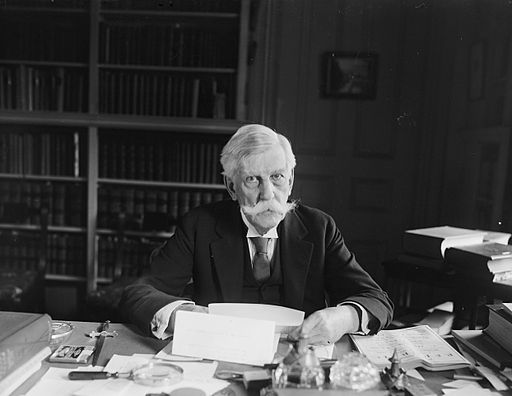
Socialist Charles T. Schenck was charged with violating the Espionage Act of 1917 when he circulated a flyer that opposed the draft. The Supreme Court upheld his conviction. Pictured is Justice Oliver Wendell Holmes who ruled in the case that the danger posed during wartime justified the restrictions on First Amendment rights to freedom of speech placed by the Espionage Act. (Photo available from the Library of Congress, public domain)
Congress enacted the Espionage Act of 1917 on June 15, two months after the United States entered World War I. Just after the war, prosecutions under the act led to landmark First Amendment precedents.
Espionage Act limited dissent to the war
The Espionage Act of 1917 prohibited obtaining information, recording pictures, or copying descriptions of any information relating to the national defense with intent or reason to believe that the information may be used for the injury of the United States or to the advantage of any foreign nation.
The act also created criminal penalties for anyone obstructing enlistment in the armed forces or causing insubordination or disloyalty in military or naval forces.
Further, the Wilson administration determined that any written materials violating the act or otherwise “urging treason” were “nonmailable matter,” and Postmaster General Albert S. Burleson ordered local postmasters to report any suspicious materials. Along with Attorney General Thomas Watt Gregory, Burleson led the way in aggressively enforcing the Espionage Act of 1917 to limit dissent.
By 1918, in actions that seriously threatened First Amendment freedoms and that likely would not be upheld today, 74 newspapers had been denied mailing privileges.
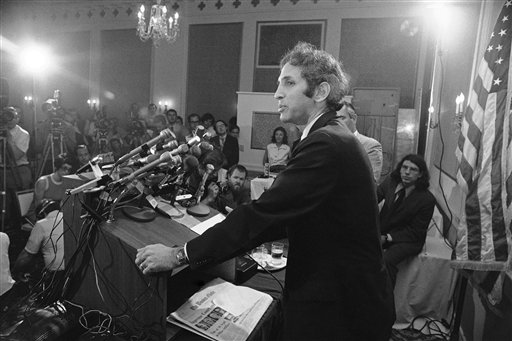
Daniel Ellsberg, pictured here, was a former defense analyst who leaked the famous Pentagon Papers to the New York Times and other newspapers. Ellsberg faced charges under the Espionage Act, and went to trial in Los Angeles in 1973. The judge eventually dismissed charges against him and his colleague Anthony Russo. (AP Photo, used with permission from the Associated Press
Court rules wartime danger justifies restrictions
In 1917 the socialist Charles T. Schenck was charged with violating the Espionage Act after circulating a flyer opposing the draft. In Schenck v. United States (1919), the Supreme Court upheld the act’s constitutionality. Writing for the majority, Justice Oliver Wendell Holmes Jr. held that the danger posed during wartime justified the act’s restriction on First Amendment rights to freedom of speech.
Although Congress repealed the Sedition Act of 1918 in 1921, many portions of the Espionage Act of 1917 are still law.
Daniel Ellsberg, a former defense analyst who leaked the famous Pentagon Papers to the New York Times and other newspapers, faced charges under the Espionage Act, and went to trial in Los Angeles in 1973. The judge eventually dismissed charges against him and his colleague Anthony Russo.
Former CIA analyst Edward Snowden was charged with violating the Epionage Act of 1917 after he leaked classified documents related to the National Security Agency’s widespread surveillance program in 2013. In this photo, Snowden speaks with Chris Anderson and Tim Berners Lee on a telepresence robot, beaming in from a secret location in Russia. (Image via Wikimedia Commons, CC BY 2.0)
People still being charged under Espionage Act
Two former lobbyists for the American Israel Public Affairs Committee (AIPAC) were charged with violating the Espionage Act of 1917 in August 2005. The charges were ultimately dropped in 2009.
In more recent years, former CIA analyst Edward Snowden was charged with violating the Epionage Act after he leaked classified documents related to the National Security Agency’s widespread surveillance program in 2013, beginning with The Guardian. Many news outlets published the information from the documents, including the New York Times, Washington Post and NBC News. Snowden sought asylum in Russia, but could be prosecuted under the charges if he returned to the United States.
In May 2019, a federal grand jury in Virginia issued an indictment against Wikileaks founder Julian Assange that included 17 counts of violation of the Espionage Act for receiving and publishing classified documents. Three of the counts are based exclusively on the act of publishing, which some have said could have implications for mainstream U.S. media publications who also sometimes publish classified material.
Some have called on repeal or changes to the Espionage Act. In 2022, for example, a new wave of criticism emerged after federal agents searched former president Donald Trump’s residence in Florida for top secret government documents that may have been taken when he left office. The search warrant referred to the Espionage Act as a possible law that had been broken.
The Espionage Act of 1917, passed by Congress two months after the United States declared war against Germany in World War I, made it a federal crime for any person to interfere with or attempt to undermine the U.S. armed forces during a war, or to in any way assist the war efforts of the nation’s enemies. Under the terms of the act, signed into law on June 15, 1917, by President Woodrow Wilson, persons convicted of such acts could be subject to fines of $10,000 and 20 years in prison. Under one still-applicable provision of the act, anyone found guilty of giving information to the enemy during wartime may be sentenced to death. The law also authorizes the removal of material considered “treasonable or seditious” from the U.S. mail.
Key Takeaways: Espionage Act of 1917
The Espionage Act of 1917 makes it a crime to interfere with or attempt to undermine or interfere with the efforts of the U.S. armed forces during a war, or to in any way assist the war efforts of the nation’s enemies.
The Espionage Act of 1917 was passed by Congress on June 15, 1917, two months after the United States entered World War I.
While The Espionage Act of 1917 limited Americans’ First Amendment Rights, it was ruled constitutional by the Supreme Court in the 1919 case of Schenck v. United States.
Potential punishments for violations of the Espionage Act of 1917 range from fines of $10,000 and 20 years in prison to the death penalty.
While the intent of the act was to define and punish acts of espionage—spying—during wartime, it necessarily placed new limits on Americans’ First Amendment rights. Under the wording of the act, anyone who publicly protested against the war, or the military draft could be open to investigation and prosecution. The non-specific language of the act made it possible for the government to target virtually anyone who opposed the war, including pacifists, neutralists, communists, anarchists, and socialists.
The law was quickly challenged in court. However, the Supreme Court, in its unanimous decision in the 1919 case of Schenck v. United States, held that when America faced “a clear and present danger,” Congress had the power to enact laws that might during times of peace be constitutionally unacceptable.
Just one year after its passage, the Espionage Act of 1917 was extended by the Sedition Act of 1918, which made it a federal crime for any person to use “disloyal, profane, scurrilous, or abusive language” about the U.S. government, the Constitution, the armed forces, or the American flag. Although the Sedition Act was repealed in December of 1920, many people faced charges of sedition in the midst of growing post-war fears of communism. Despite the total repeal of the Sedition Act, several provisions of the Espionage Act of 1917 remain in effect today.
History of the Espionage Act
The outbreak of World War I shook America and Americans out of a more than 140 year-long self-imposed period of isolationism. Fears of internal threats posed especially by foreign-born Americans grew quickly. In his State of the Union address on December 7, 1915, almost two years before the U.S. would enter the war in 1917, President Wilson forcefully urged Congress to pass the Espionage Act.
“There are citizens of the United States, I blush to admit, born under other flags but welcomed under our generous naturalization laws to the full freedom and opportunity of America, who have poured the poison of disloyalty into the very arteries of our national life; who have sought to bring the authority and good name of our Government into contempt, to destroy our industries wherever they thought it effective for their vindictive purposes to strike at them, and to debase our politics to the uses of foreign intrigue ...
“I urge you to enact such laws at the earliest possible moment and feel that in doing so I am urging you to do nothing less than save the honor and self-respect of the nation. Such creatures of passion, disloyalty, and anarchy must be crushed out. They are not many, but they are infinitely malignant, and the hand of our power should close over them at once. They have formed plots to destroy property, they have entered into conspiracies against the neutrality of the Government. They have sought to pry into every confidential transaction of the Government in order to serve interests alien to our own. It is possible to deal with these things very effectually. I need not suggest the terms in which they may be dealt with.”
Despite Wilson’s passionate appeal, Congress was slow to act. On February 3, 1917, the U.S. officially broke diplomatic relations with Germany. Although the Senate passed a version of the Espionage Act on February 20, the House decided not to vote before the end of the current session of Congress. Shortly after declaring war against Germany on April 2, 1917, both the House and Senate debated versions of the Wilson administration’s Espionage Act that included strict censorship of the press.
The provision for press censorship—an apparent suspension of a First Amendment right—stirred stiff opposition in Congress, with critics arguing that it would grant the president unlimited power to decide what information “might” be harmful to the war effort. After weeks of debate, the Senate, by a vote of 39 to 38, removed the censorship provision from the final law. Despite the removal of his press censorship provision, President Wilson signed the Espionage Act into law on June 15, 1917. However, in a memorable bill signing statement, Wilson insisted that press censorship was still needed. “Authority to exercise censorship over the press … is absolutely necessary to the public safety,” he said.
Famous Prosecutions under the Espionage and Sedition Acts
Since World War I, several Americans have been convicted or indicted for violations of the espionage and the sedition acts. A few of the more notable cases include:
Eugene V. Debs
In 1918, prominent labor leader and five-time Socialist Party of America presidential candidate Eugene V. Debs, who had long criticized America’s involvement in the war, gave a speech in Ohio urging young men to resist registering for the military draft. As a result of the speech, Debs was arrested and charged with 10 counts of sedition. On September 12, he was found guilty on all counts and sentenced to 10 years in prison and denied the right to vote for the rest of his life.
Debs appealed his conviction to the Supreme Court, which unanimously ruled against him. In upholding Debs’ conviction, the Court relied on the precedent set in the earlier case of Schenck v. United States, which held that speech that could potentially undermine society or the U.S. government was not protected under the First Amendment.
Debs, who actually ran for president from his jail cell in 1920, served three years in prison, during which his health deteriorated rapidly. On December 23, 1921, President Warren G. Harding commuted Debs’ sentence to time served.
Julius and Ethel Rosenberg
In August 1950, American citizens Julius and Ethel Rosenberg were indicted on charges of spying for the Soviet Union. At a time when the United States was the only country in the world known to have nuclear weapons, the Rosenbergs were accused of giving the USSR top-secret nuclear weapon designs, along with information about radar, sonar, and jet engines.
After a long and controversial trial, the Rosenbergs were convicted of espionage and sentenced to death under Section 2 of the Espionage Act of 1917. The sentence was carried out at sundown on June 19, 1953.
Daniel Ellsberg
In June 1971, Daniel Ellsberg, former U.S. military analyst working for the RAND Corporation think tank, created a political firestorm when he gave the New York Times and other newspapers the Pentagon Papers, a top-secret Pentagon report on President Richard Nixon’s and his administration’s decision-making process in conducting and continuing America’s participation in the Vietnam War.
On January 3, 1973, Ellsberg was charged with violations of the Espionage Act of 1917, as well as theft and conspiracy. In all, the charges against him carried a total maximum prison sentence of 115 years. However, on May 11, 1973, Judge William Matthew Byrne Jr. dismissed all charges against Ellsberg, after finding that the government had illegally collected and handled evidence against him.
Chelsea Manning
In July 2013, former U.S. Army Private First Class Chelsea Manning was convicted by a military court-martial for violations of the Espionage Act relating to her disclosure of nearly 750,000 classified or sensitive military documents on the wars in Iraq and Afghanistan to the whistleblower website WikiLeaks. The documents contained information on more than 700 prisoners detained at Guantánamo Bay, a U.S. airstrike in Afghanistan that killed civilians, over 250,000 sensitive U.S. diplomatic cables, and other Army reports.
Originally facing 22 charges, including aiding the enemy, which could have brought the death penalty, Manning pleaded guilty to 10 of the charges. In her court martial trials in June 2013, Manning was convicted on 21 of the charges but was acquitted of aiding the enemy. Manning was sentenced to serve 35-years at the maximum-security disciplinary barracks at Fort Leavenworth, Kansas. However, on January 17, 2017, President Barack Obama commuted her sentence to the nearly seven years she had already been held.
Edward Snowden
In June 2013, Edward Snowden was charged under the Espionage Act of 1917 with “unauthorized communication of national defense information” and “willful communication of classified intelligence with an unauthorized person.” Snowden, a former CIA employee and U.S. government contractor, leaked thousands of classified National Security Agency (NSA) documents dealing with several U.S. global surveillance programs to journalists. Snowden’s actions came to light after details from the documents appeared in The Guardian, The Washington Post, Der Spiegel, and The New York Times.
Two days after his indictment, Snowden fled to Russia, where he was eventually granted asylum for one year after being held at Moscow's Sheremetyevo Airport for over a month by Russian authorities. The Russian government has since granted Snowden asylum until 2020. Now president of the Freedom of the Press Foundation, Snowden continues to live in Moscow while seeking asylum in another country. Snowden and his disclosures have fueled wide debate over mass government surveillance of the people and the balance between the interests of national security and personal privacy.
The Espionage Act of 1917 Today
As evidenced especially by the recent cases of Ellsberg, Manning, and Snowden, several provisions of the Espionage Act of 1917 remain in effect today. These provisions are listed in the United States Code (USC) under Title 18, Chapter 37—Espionage and Censorship.
As when it was first enacted, the Espionage Act still criminalizes the act of spying for or otherwise aiding an enemy of the United States. However, it has since been expanded to punish people who, for any reason, divulge or share classified government information without permission. Even in the most recent administrations, a handful of people have been charged or convicted under the Espionage Act.