Thursday, March 19, 2026

How Iran and China Shaped the War Chessboard

How Iran and China Shaped the War Chessboard

China’s dual-track response to the US–Israeli war on Iran reflects a broader geopolitical and economic strategy that stretches from the battlefield to the global financial system.


Pepe Escobar, The Cradle

March 18, 2026

China is officially responding on two parallel tracks to the Epstein Syndicate – or US-Israeli – war on Iran via a diplomatic spokesman and a military spokesman.

Translation: China sees the war both as an extreme political/diplomatic tension and a military threat.

China’s military spokesman, a People’s Liberation Army (PLA) colonel, speaks with metaphors. It was he who said explicitly that the US is “addicted to war”, with only 250 years of History and only 16 years of peace.

He clearly positions the US as a global threat. And clearly, also as a moral (italics mine) threat.

Chinese President Xi Jinping is firmly focused on establishing a long-lasting connection between Marxism and Confucianism.

The key contribution of Confucius to political thinking is the precise use of language. Only the one who speaks with precise metaphors and moral weight is able to govern a nation.

So China is carefully developing a steady moral and ethical criticism of the American war of choice on Iran. Stressing how this is the attack of a nation that has lost its moral compass.

The Global South totally understands the message.

Additionally, facts on the battlefield show how China has also changed the rules of war in Iran.

The Iranian grid is now fully connected to the BeiDou satellite system. That explains how Iran now strikes with precision, and every move by the US-Israeli combo faces a China-tech Digital Wall (over 40 BeiDou satellites in orbit). That accounts for excellent Iranian missile accuracy and increased resistance to jamming.

As part of their 25-year Comprehensive Strategic Partnership, China has also supplied Iran with long-range radars, integrated with satellite systems. The key takeaway is Iran’s now much shorter response time compared to the 12-day war.

Russia has helped on a parallel track, allowing Iran to apply in spades what Russia learned in Ukraine about western systems such as Patriot and IRIS-T. It’s not only about mass-drone saturation tactics; it’s learning the Russian way of coordinating drone swarms with ballistic missile volleys. That’s exactly what’s in – devastating – effect in the latest stages of Operation True Promise IV.

Playing Go: It’s all about the petroyuan 

Now let’s focus on the crucial Strait of Hormuz gambit. The key move is Iran only allowing transit for oil tankers whose cargo has been settled in petroyuan. No dollars. No euros. Only yuan.

In fact, China had already started to end the Bretton Woods/petrodollar system in December 2022, when Beijing invited the Gulf Cooperation Council (GCC) petro-monarchies to trade oil and gas on the Shanghai Stock Exchange.

Now, couple all of the above with the Chinese 15th Five-Year-Plan, just discussed and approved in Beijing.

Talk about an in-depth systemic vision.

In a quite holistic way, Beijing planners set GDP growth at four percent; the digital economy advancing to 12.5 percent of GDP; green energy solutions at 25 percent; surface water quality at 85 percent; an avalanche of high-value patents; all that and more, equally tabled, with hard targets to be achieved and binding indicators all the way to 2030.

This means the Chinese are treating economy, energy security, ecology, education, and health care as if they are organs of the same fit body. That is how urbanization fuels productivity: a lot of investment in R&D fuels more and more patents; patents fuel the digital economy; and green energy solutions fuel strategic independence.

The latest Five-Year Plan conclusively shows how China is meticulously planning to be the leader of the coming tech future. And this goes way beyond 2030, all the way to mid-century.

It’s no wonder that smashing the petrodollar plays a key role in this process of changing the current system of international relations. Iran is now offering it on a plate to China, by replacing the petrodollar with the petroyuan in the most critical chokepoint on the planet, through which transits 20 percent of all global oil.

Iran’s play is not military; it’s financially (italics mine) nuclear. What makes it all easier is that Iran is already offering the model for the rest of the Global South to follow: nearly 90 percent of Tehran’s crude exports are settled in yuan via the CIPS payment system.

The Global South may eventually lock in the very simple model. Tehran is not saying the Strait of Hormuz is blocked. It’s blocked only to the hostile Epstein Syndicate – the US – and its minions trading in petrodollars. Shipping lanes are being turned in real time into political filters. As the Global South migrates to the petroyuan, the hegemonic petrodollar – since 1974 – drops dead.

By now, every trader on the planet knows how the petrodollar works. After the 1973 oil shock, the GCC and OPEC agreed in 1974 that oil could only be traded in US dollars.

Oil exporters must necessarily recycle their dollar profits back into US Treasury bonds and stocks. That reinforces the role of the US dollar as reserve currency; finances US tech investments; finances the industrial-military complex, and their Forever Wars; and most of all, de facto finances the – unpayable – US debt.

China, Russia, and Iran, as BRICS members, happen to be on the frontline of advancing alternative payment systems; crucially, that includes bypassing the petrodollar.

So this is way more than control of oil – the alleged rationale behind the shambolic, unplanned “excursion” (Trump terminology) into Iran.

For all practical purposes, the facts on the ground are already spelling Major Fail. It’s the counterpunch that is on a whole new level.

The IRGC goes Sun Tzu 

Weaponizing the Strait of Hormuz is Sun Tzu, revised by Iran’s Islamic Revolutionary Guard Corps (IRGC). Both a connectivity corridor – the Strait of Hormuz – and a currency – the yuan – are now weapons of imperial destruction. Who needs a nuclear bomb?

What’s at stake is the control of the global financial system – way beyond 2030, all the way to mid-century and beyond. What we are watching in real time is the Persians playing chess – in which they excel – but with elements of Chinese weiqi (“Go” in English).

Go is organic. When the little stones used in the game connect, they mold shape and long-term control across the entire board. In our case, the geopolitical/geoeconomic chessboard. It’s all about positioning, patience, accumulating advantages, and managing strategy.

That’s the “secret” of why the war on Iran now offers China the decisive move. Beijing has been shaping the chessboard for years with infinite patience: creating a set of multi-lateral institutions; playing a key role in BRICS and SCO; building the New Silk Roads (BRI); investing in alternative settlement systems; turbo-charging its diplomacy.

Go is extremely rational. If you shape the board correctly, you will not fail. The game plays itself. That’s where we are now. And that’s why the Imperial Vociferator, along with his sycophants, enablers, and vassals, is stunned and petrified: a prisoner of his own quagmire of hubris.

This article was originally published on The Cradle.

Pepe Escobar is an independent geopolitical analyst and author. His latest book is Raging Twenties. He’s been politically canceled from Facebook and Twitter. Follow him on Telegram.


Copyright © The Cradle, Pepe Escobar

-----------------------

Source

https://www.lewrockwell.com/2026/03/no_author/how-iran-and-china-shaped-the-war-chessboard/


Wednesday, March 18, 2026

A New Study Challenges the Climate Establishment’s Key Warming Metric

A New Study Challenges the Climate Establishment’s Key Warming Metric

March 18, 2026

For years the public has been told that the science of climate change is settled. Governments, media outlets, and international organizations frequently assert that the evidence for dangerous planetary warming is overwhelming.

Yet one of the most important measurements supporting that claim is now being challenged by new scientific research.

An international team of scientists has published a study arguing that the primary method used to estimate global ocean heat content — a central metric used in modern climate assessments — may be fundamentally flawed. If their analysis is correct, one of the key pillars supporting claims of a steadily warming planet could be far less certain than widely believed.

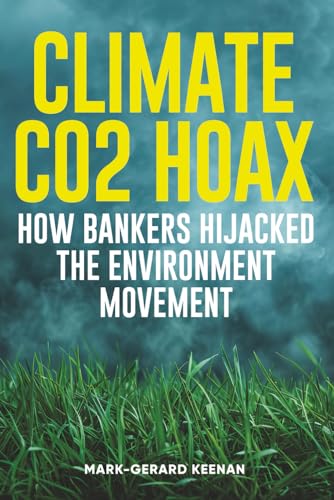
The implications could be significant, because ocean heat measurements play a crucial role in the conclusions reached by the United Nations’ Intergovernmental Panel on Climate Change (IPCC).Climate CO2 Hoax - How... Keenan, Mark Gerard Check Amazon for Pricing.

Why ocean heat matters

In recent years climate scientists have increasingly focused on the oceans when trying to determine whether the Earth is accumulating excess heat.

The reasoning is straightforward. The oceans store vastly more heat than the atmosphere. If the planet is truly warming due to greenhouse gases, the oceans should be absorbing much of that energy.

According to IPCC assessments, the Earth is currently accumulating energy at roughly 0.7 watts per square meter of the planet’s surface. That number may sound small, but spread across the entire globe it represents an enormous amount of heat.

This estimate has become a central figure in modern climate science. It is frequently cited as evidence that the Earth’s climate system is experiencing a persistent “energy imbalance.”

But measuring something as complex as the heat content of the entire global ocean is far from simple.

The global network of floating sensors

Much of the data used to estimate ocean heat content comes from the international Argo Program.

The Argo system consists of approximately 4,000 autonomous floats drifting throughout the world’s oceans. These instruments periodically descend into the water column, measuring temperatures at various depths before resurfacing every ten days to transmit their data via satellite.

Over the past two decades this network has revolutionized ocean monitoring. Before Argo existed, scientists had far fewer direct observations of ocean temperatures.

But the new study argues that the way these measurements are used to estimate global heat accumulation contains several serious weaknesses.

Vast areas of ocean remain unmeasured

Although 4,000 instruments may sound like a large number, the world’s oceans cover more than 360 million square kilometers.

Argo floats are typically separated by distances of 200 to 500 kilometers. This means enormous regions of the ocean are never directly measured.

Instead, scientists estimate conditions in those regions using mathematical interpolation — essentially filling in gaps with computer models.

The floats themselves also introduce additional uncertainties. While submerged, they drift with ocean currents and do not know their precise location. Their positions are recorded only when they surface to transmit data.

As a result, temperature measurements may be assigned to locations that differ significantly from where the measurements were actually taken.

The floats also generally measure temperatures only down to depths of about 2,000 meters. Yet much of the ocean lies far deeper. Roughly half the ocean’s volume remains largely unobserved.

Polar regions present further difficulties, since sea ice prevents floats from operating normally.

Taken together, these limitations raise important questions about how accurately current observations represent the true thermal state of the global ocean.Transcending the Clima... Keenan, Mr Mark Christ... Check Amazon for Pricing.

The problem of uncertainty

The new research examines how these measurement gaps and uncertainties affect estimates of global ocean heat content.

The IPCC’s widely cited estimate suggests the Earth is gaining energy at about 0.7 watts per square meter.

But when the researchers recalculated the uncertainty surrounding that figure, they found something striking.

The true uncertainty may exceed ±1 watt per square meter.

In statistical terms, this means the estimated warming signal could be indistinguishable from zero.

That does not prove the Earth is not warming. But it does mean that current observational data may not be capable of measuring the planetary energy imbalance with the precision often claimed.

A deeper scientific issue

The paper also touches on a more fundamental theoretical problem that has been debated among physicists for years.

Temperature describes the state of a system at a particular location and time. Averaging temperatures across vastly different regions of a complex system that is not in thermodynamic equilibrium can produce numbers that may lack clear physical meaning.

The Earth’s atmosphere and oceans are precisely such systems.

Some researchers have long argued that global temperature averages and related metrics may therefore be less physically meaningful than commonly assumed.

The new study extends this critique to calculations of global ocean heat content.

The policy implications

Why does this matter?

Because climate policy is increasingly being built on the assumption that scientists possess precise measurements of the planet’s energy balance.

Governments are redesigning energy systems, imposing regulations on industry, and directing trillions of dollars in investment based on those assessments.

If the foundational measurements behind those assessments turn out to be far more uncertain than believed, the policy implications could be substantial.The Truth about Energy... Corsi Ph.D., Jerome R. Check Amazon for Pricing.

Scientific debate should not be viewed as a threat to science. It is how science progresses.

Yet the public discussion of climate change often discourages open examination of underlying assumptions and measurements.

When new research raises fundamental questions about key metrics used in climate assessments, those questions deserve serious attention.

The climate debate is often presented as settled.

But as this new study illustrates, some of the most important measurements used to support that conclusion may still be subject to significant scientific uncertainty.

This raises broader questions about the growing role of centralized institutions in directing economic and scientific narratives without meaningful independent oversight.


Mark Keenan is a former United Nations technical expert and an independent writer on science, technology, political economy, and human freedom. He is the author of Climate CO2 Hoax, Godless Fake Science, The AI Illusion and The Debt Machine, He publishes essays at markgerardkeenan.substack.com and comments on X (@TheMarkGerard). His work is archived at Reality Books.

---------------------------------------

Source

 https://www.lewrockwell.com/2026/03/mark-keenan/a-new-study-challenges-the-climate-establishments-key-warming-metric/


Sunday, March 15, 2026

Echoes of Iraq: Mainstream media ‘deja vu’ over framing of the war on Iran

Echoes of Iraq: Mainstream media ‘deja vu’ over framing of the war on Iran

Media analysis indicates parallels between headlines from Iraq war to current response to US and Israeli bombardment of Iran

“Why we should go to war” ran the headline of a Guardian article in February 2003 by the commentator Julie Burchill. 

In it, she explained to the Guardian’s liberal readers why a pro-war attitude in the run-up to former British Prime Minister Tony Blair’s invasion of Iraq should be welcomed. 

“If you really think it's better for more people to die over decades under a tyrannical regime than for fewer people to die during a brief attack by an outside power, you're really weird and nationalistic and not any sort of socialist that I recognise,” wrote Burchill.

Another article published in April 2003, after the invasion started, criticised anti-war “doomsters”, claiming “the people of Iraq have been unchained from appalling torture and tyranny” as a result of US-UK action.

Despite claims of the BBC’s anti-war bias from Downing Street, academic analysis proved that it was in fact more reliant on government and military sources than other sources.

It was also the least likely to quote sources of Iraqi or independent origin, such as the Red Cross, which might contradict official narratives that underplayed Iraqi casualties.

Two decades after Iraq, how much has changed?

Many media outlets have issued mea culpas for their parroting of US and British propaganda lines in the run-up to the invasion of Iraq but when it comes to the latest conflict in Iran, it seems clear that that introspection did not lead to lasting change.

Media analysts Middle East Eye spoke to say that once again the media is failing in its coverage of the current US-Israeli attacks on Iran. 

Coverage by news outlets is perhaps more tentative in its support for war given the lessons editors have learnt after Iraq, but many of the same issues keep turning up.

Leaving out unflattering details

The bombardment of Iran by Israel and Washington has already led to more than 1200 deaths, including 165 people, almost all schoolchildren aged between seven and 12, killed by US “double-tap” strikes on a school.

Such strikes are designed to take out medics and civilians arriving at the scene to help victims in a delayed double explosion. 

Declassified UK reported a Scottish weapons factory helped to make missiles allegedly used in the attack, which the UN education agency, Unesco, described as a “grave violation of international law”. 

So far, no mainstream media have reported on this UK link to the attack.

Instead media outlets have repeatedly raised doubts about who was behind the attack.

One BBC headline from 28 February read “At least 153 dead after reported strike on school, Iran says”. 

Analysts have pointed out the use of the passive voice, lack of a named aggressor, and implication of doubt regarding the reliability of the source.

It was a New York Times report that first revealed the US as the likely culprits behind the attack - a conclusion that has since become firmer as evidence comes out, despite Washington’s reluctance to accept responsibility.

Elsewhere, Sky News called Iran’s bombing of Israel a “horror story”, but has avoided the use of similar language to describe the plight of Iranians living under US bombardment.

If Trump attacks Iran, western media will be cheering him on

An article in The Telegraph justified US-Israeli attacks by accusing critics of “erasing the history of the regime’s terror”.

Nonetheless, this time round the lack of a persuasive reason for the war from the Trump administration has meant a break from the cohesive media narrative that accompanied the Iraq war.

According to Ali Alavi, lecturer in Middle Eastern and Iranian Studies at SOAS, while the 2003 invasion of Iraq followed the “shock of 9/11, when much of the western political class and media converged around a single security narrative about Saddam Hussein”, the response to the war on Iran “appears much more fragmented”.

He said that the coverage is “less uniformly aligned with political messaging” with a “lack of consensus” around the framing and justification for the war.

Part of this stems from the fact that the Trump administration has been characteristically chaotic in establishing the aims of the war: with conflicting narratives around “regime change”, preventing nuclear capabilities and taking out an immediate threat.

WMDs and other lies

During the lead-up to the Iraq War, press reporting repeated the so-called “45-minute claim” on how long it would take Saddam Hussein’s non-existent weapons of mass destruction (WMDs) to reach the UK. 

Most notably, the Sun ran a sensationalist headline “Brits 45 mins from doom” following the publication of the September 2002 dossier which served as justification for Prime Minister Tony Blair’s invasion of Iraq the following year. 

Similarly, The Sunday Telegraph pumped out headlines like “UN inspectors uncover proof of Saddam’s nuclear bomb plans” and “UN gives Iraq last chance to disarm” to pave the way for the illegal invasion.

'The clear fact is that the media do not represent these [anti-war] views and cater overwhelmingly to the most hawkish voices in government'

- Des Freeman, Goldsmiths University

The BBC was attacked by Blair’s government for raising concerns that the intelligence dossier about Iraq’s WMDs had been “sexed up” by the prime minister’s office. 

The subsequent fallout led to resignations from the BBC’s chairman and director general.

However, the publication of the Chilcot report in 2016 later vindicated their claims that Blair and his director of communications, Alastair Campbell, had exaggerated the threat posed by Saddam Hussein. 

The inquiry found Iraq posed “no imminent threat” and British intelligence agencies had produced “flawed information” about the alleged WMDs.

Fast forward to 2026 and Israeli officials are claiming they launched a “pre-emptive attack against Iran” while Trump cited an “imminent threat” to the US, despite Pentagon briefings directly contradicting the narrative that Iran would strike unprovoked.

The claims that Iran poses an existential threat have been repeated in British mainstream media and Iran's supposed nuclear weapons ambitions are spoken of as a matter of fact.

For example, The Times ran a story on Thursday with the headline “How close is Iran to building a nuclear weapon?” 

“US-Israeli attacks are targeting Tehran’s atomic programme once more, suggesting Trump’s bunker-busting bombs last year did not entirely obliterate the threat,” the article continues.

Evening standard 45 minute frontpage
The Evening Standard's infamous '45 minutes' frontpage (Evening Standard)

What the article fails to mention is that Iran had just made major concessions in settlements regarding its nuclear programme. 

Omani Foreign Minister Badr al-Busaidi, who has been mediating the process, told CBS News that negotiators from the US and Iran had made “substantial progress” and that a nuclear “deal is within our reach”, just one day before the US and Israel attacked the region.

Iran agreed to blend existing stockpiles of enriched uranium to their “lowest level possible” and grant inspectors from the International Atomic Energy Agency (IAEA) “full access” to its nuclear sites.

Meanwhile, Israel refuses to acknowledge its own nuclear programme, has rejected IAEA inspections, and, unlike Iran, is not part of the Nuclear Non-Proliferation Treaty.

Rarely mentioned is the fact that western states have been intervening in the region, including militarily, before weapons of mass destruction were ever an issue.

In 1953, US and British intelligence operatives organised a coup against Iran’s democratically elected leader, Mohammad Mosaddegh after he nationalised Iran’s oil.

The Shah’s rule was strengthened and the Anglo-Iranian Oil Company (now known as BP) resumed its control of Iranian oil.

The CIA also helped overthrow Iraq’s president, Abdul-Karim Qasim, the general who deposed the western-allied Iraqi monarchy, in a 1963 coup.

When the Shah was overthrown during the 1979 Iranian revolution, the US backed Iraq’s Saddam Hussein, providing arms and intelligence to fight the newly anti-western Iran. Britain and Germany supplied Saddam with equipment and materials for the manufacture of chemical weapons during the war.

When Saddam Hussein no longer supported western interests and became the new bete noire by invading Kuwait in 1990, the US led a war against Iraq.

Embedded journalists

Catriona Pennell, professor of Modern History and Memory Studies at Exeter, told MEE that, in 2003, during “a perceived moment of crisis, the press tended to support the national cause… transmitting information on behalf of governments, rather than acting as a critical filter.”

Media analysts found that less than 10 percent of news stories covering the Iraq war featured controversial issues such as “civilian casualties and antiwar protest”.

'The camera-angle is from Israel and from Washington rather than Iran'

- Gholam Khiabany, Goldsmiths, University of London

Under six percent focused on “the rationale for war”, with the vast majority of reporting being “event-driven” by “embedded journalists” accompanying military personnel on the ground. 

For academic Gholam Khiabany, who teaches at Goldsmiths, University of London, the fact that the media are reporting on Iran largely from inside Tel Aviv is telling.

“The camera-angle is from Israel and from Washington rather than Iran,” he explained, likening it to the media’s coverage of Israel’s genocide in Gaza, which emphasised death toll figures came from the “Hamas-run health ministry” to imply they were unreliable.

According to Philip Seib, professor of Journalism and Public Diplomacy at the University of Southern California, while “cinematic but simplistic news coverage bolstered the early support for the invasion” in Iraq, the argument of “Iran as an existential threat to the United States exists only in the troubled brain of Donald Trump”.

Opposition to the Iraq war grew steadily, culminating in the two-million-person march in February 2003 organised by Stop the War.

Public scepticism

Lindsey German, co-founder of Stop the War, which recently organised the 50,000-strong London demonstration against attacks on Iran on Saturday, said that the Independent and the Daily Mirror were the only major British outlets to highlight widespread opposition to the Iraq war. 

The aftermath of Iraq – British military losses, vast Iraqi civilian casualties, the absence of WMDs – has contributed to a more cautious response from Keir Starmer, whose popularity is lower than even Blair’s worst moments. 

War on Gaza: How US mainstream media incites hate of Arabs and Muslims

“The legacy of Iraq weighs very heavily on the Labour government,” German told MEE, noting Starmer frames support for US and Israeli attacks as being for “defensive purposes”, despite criticism from both Blair and Trump.

Trump is also a much less credible source when it comes to justifying bombing civilians in the name of Iranian women’s freedom, given his extensive ties to the late paedophile Jeffrey Epstein, track record of misogynistic comments, and allegations of sexual assault involving underage girls. 

While the media might maintain a lot of the narrative cohesion that accompanied the Iraq War, the same cannot be said about the general public in both the US and UK.

Recent YouGov polling indicates that a majority (59 percent) of the British public oppose US military action against Iran and only eight percent want the UK “actively joining” attacks.

More than half of Americans also oppose the war on Iran, with opposition to the use of ground troops rising to 74 percent, according to the pollster Quinnipiac.

Des Freedman, professor of media and communications at Goldsmiths University, told MEE “the clear fact is that the media do not represent these views and cater overwhelmingly to the most hawkish voices in government”.

These voices he said issue “a cacophony of noise that we have to move to a war footing and increase the defence budget, even if that means shredding public services”. 

The chaos surrounding Trump has “allowed sections of the media to report more critically and to focus on the lack of military planning on the part of the US, justifying the UK not playing a more defensive role”.

Nevertheless, Freedman noted, as with Iraq, “very few journalists ask the key questions about how any of this can be justified in international law.”

-----------------------

Source

https://www.middleeasteye.net/discover/echoes-iraq-mainstream-media-deja-vu-over-framing-war-iran

Saturday, March 14, 2026

Who Needs Glyphosate?

Who Needs Glyphosate?


Intellectuals Paved the Road to Serfdom

Intellectuals Paved the Road to Serfdom   James Bovard  -  The Future of Freedom Foundation October 15, 2026 In the same way that medieval k...